

The aloe vera plant is primarily known for its moisturizing effect and is therefore an integral part of many cosmetic products. As a succulent, it stores water in its thick leaves, making it particularly easy to care for – perfect for keeping as a houseplant. Here's how to properly care for your aloe vera.
Contents
- Caring for an Aloe Vera Houseplant - The Right Way
- Aloe Vera Plant Profile
- The Right Location for the Aloe Vera Plant - How Much Sun is Needed?
- Aloe Vera Plant - Which Soil?
- Watering the Aloe Vera Plant - How Much Water Does It Need?
- Aloe Vera Plant has brown leaves?
- Aloe Vera Winter Care
- Cutting and Propagating Aloe Vera Plant
- Repotting Aloe Vera Plant
- Harvesting Aloe Vera Plant
- Pests for Aloe Vera
- Common Mistakes in Aloe Vera Plant Care
- FAQ - Your Questions about the Aloe Vera Houseplant
Aloe Vera Houseplant: How to Grow It Healthily in Your Home

If you're someone without a green thumb, then the aloe vera plant is definitely a suitable houseplant for you. It's extremely undemanding and requires little care. Therefore, with just a few measures, it can thrive perfectly and, in addition to being a beautiful sight, also ensure good air quality. With proper care, it is robust, long-lasting, and easy to care for – even for beginners.
🌞 lots of sun
🌡️ 18 °C - 27 °C room temperature
💦 little water
🌵cactus and succulent soil
Profile: Aloe Vera Plant
Botanical Name: Aloe barbadensis Miller
Plant Family: Asphodelaceae
Origin: Arabian Peninsula
Current Distribution: Dry and subtropical regions worldwide (e.g., Mexico, Canaries, Africa)
Growth Form: succulent leaf rosette
Growth Height: approx. 40–60 cm as a houseplant
Leaves: fleshy, water-storing, serrated leaf margins
Flowers: yellow to orange, rare indoors
Location: very bright, sunny
Temperature: warm, frost-sensitive (not below 5 °C)
Watering: sparingly, avoid waterlogging
Soil: well-draining, sandy-mineral (cactus soil suitable)
Special Feature: stores water in leaf gel and survives long dry periods
Propagation: offsets ("pups")
The right location for the Aloe Vera houseplant - how much sun is needed?
The Aloe Vera plant probably originates from the Arabian Peninsula. Today it can be found in all tropical and subtropical regions. It is therefore not sufficiently winter-hardy and feels much more at home in dry and sunny areas. For proper care, it is important to find a suitable location that provides the houseplant with plenty of light and is adequately heated. Sunny spots are fine for the Aloe Vera plant, but too much sun and heat will dry out the leaf tips and quickly dry out the soil. Therefore, it is advisable to slowly acclimatize the plant to the sun. As a succulent, the Aloe Vera does not require excessive humidity and tolerates some dryness without problems.
Aloe Vera Plant - Which Soil?
For succulents, special cactus and succulent soil is recommended, but conventional potting soil can also be used. To provide the aloe vera plant with sufficient nutrients, soil mixed with sand or seramis is suitable. This increases the soil's permeability and prevents harmful waterlogging.
Optionally, the evergreen succulent can be fertilized every two weeks with cactus fertilizer added to the water.
Watering the Aloe Vera Plant - How Much Water Does It Need?
The aloe vera is a very easy-to-care-for houseplant and requires little water. But what is particularly important is the way it is watered:
Even though conventional watering (overhead watering) is unproblematic for many plants, it is different for rosette-forming plants, which include aloe vera. Its leaves are arranged circularly in the center of the bulb, from which new leaves emerge. If you water them overhead, water collects in the spaces between the leaves, it cannot drain away and rot can set in.
Correct watering of aloe vera means only moistening the soil. The water must drain well and not accumulate. Soil that is too wet or clogged drainage holes at the bottom of the pot will lead to root rot and the death of the houseplant. Ideally, lime-free rainwater or soft water should be used for watering.

If a thick layer of dust has settled on the leaves, you can, exceptionally, carefully rinse them off or wipe them away. After watering, it is advisable to tilt the aloe so that the remaining water can drain out.
How often do you need to water your aloe vera? The water requirements of aloe vera are determined by location factors such as soil, light, temperature, or air circulation. Therefore, general recommendations, such as watering once a day or twice a week, are not applicable. It is therefore advisable to check the soil moisture with your finger. If the top layer of soil is dry, the medicinal aloe vera plant is watered from below.
The most important points to consider when watering aloe vera:
- Less is more: Aloe vera prefers dry conditions. Only water it when the top layer of soil is completely dry. This can take between one and three weeks, depending on the season.
- Thorough, but infrequent: Water the plant thoroughly so that the water reaches the roots. However, make sure that excess water can drain off well to avoid waterlogging.
- Avoid waterlogging: Use a pot with drainage holes and well-draining soil (e.g., cactus soil or a mixture of potting soil and sand). You should remove excess water from the saucer after watering.
-
Consider the season:
- Spring & Summer: Water every 1–2 weeks when the soil is dry.
- Autumn & Winter: Water significantly less often (every 3–4 weeks), as the plant needs less water during this time.
- Proper watering method: Avoid water getting directly into the leaf rosette, as this can cause rot. Instead, water directly into the soil.
Aloe Vera Plant has brown leaves?
If your aloe vera houseplant gets brown leaves, there can be various reasons:
- Too much water – Waterlogging is the most common reason. If the roots stay wet for too long, the plant can start to rot, which shows as brown, mushy leaves.
- Too little water – Although aloe vera is drought-resistant, its leaves can become brown and dry if it gets too little water for an extended period.
- Too much direct sun – Strong sunlight, especially in summer, can cause sunburn, which manifests as brown spots or a brownish discoloration of the leaves.
- Incorrect substrate – A poorly draining, too dense substrate can promote waterlogging and damage the roots. Special cactus soil or a mixture of potting soil and sand is best.
- Cold or drafts – Aloe vera is a heat-loving plant. Temperatures below 10 °C or cold drafts can cause stress and lead to brown leaves.
- Nutrient deficiency or over-fertilization – Too little or too much fertilizer can also cause brown leaves. Aloe vera needs only a few nutrients and should be supplied with a mild cactus fertilizer at most every few weeks.
The solution? Cut off brown leaves (see next point) and place the aloe vera plant in a suitable location, avoid waterlogging, water moderately, and replace the soil if necessary.
Aloe Vera Winter Care
In winter, the aloe vera needs a resting phase. Place the plant in a location that is as bright and slightly cooler (ideally around 10-15 °C), e.g., by a bright window not directly near a heater. During this time, water much less often; usually, it is enough to lightly moisten the soil every few weeks. Waterlogging must be avoided at all costs, as the roots are particularly sensitive during the low-light period. Do not fertilize in winter, and from spring onwards, the amount of water can slowly be increased again.
Make sure that the temperature never drops, as the plant can already suffer damage at four degrees.
Cutting and propagating Aloe Vera Plant

If the aloe vera leaves become dry or brown, they must be removed so that the aloe vera plant can thrive without problems. Cut the leaves close to the stem.
To take cuttings and propagate the aloe vera, cut a leaf measuring 5 to 7 cm from the mother plant. This leaf must be left to dry for two days until the cut wound has healed. Then the cutting can be planted with the cut end facing down into a pot of soil. It is advisable to wait one week before watering the cutting for the first time. Here, it is enough to merely moisten the soil. If the cutting develops delicate roots and establishes itself in the pot, it can be repotted to continue growing.
Repotting Aloe Vera Houseplant
Repotting becomes necessary when the aloe vera forms so-called pups and the pot becomes overgrown or the plant grows very wide.
Repotting an aloe vera plant in 8 steps:
- Let it dry for a few days so that the soil separates better from the roots
- Grasp the plant at the base and pull it out
- Shake out and loosen the root ball
- Remove dead leaves or roots
- Remove parts of the old soil
- Fill the new pot partly with soil and substrate and place the plant upright
- Fill cavities with soil and press lightly
- Don't forget to water (only moisten the soil)
Repotting is still stressful for plants. Although aloe vera loves sun and dryness, the evergreen houseplant should be placed in a bright, but not fully sunny, location for one to two weeks after repotting. This allows it to recover and slowly stimulate root formation.
Harvesting Aloe Vera Houseplant

The healing power of aloe vera lies in the gel-like plant sap of its leaves. However, the full nutrient density and thus effectiveness is only achieved after approximately 1.5 - 5 years and depends largely on the soil and the time the plant can thrive. Ideal climatic conditions are also beneficial. Therefore, it is particularly important that the aloe vera, which is to be used as direct juice or for cosmetics, grows for a corresponding period under ideal conditions to then be processed into a high-quality product. The plant can best be harvested only when it has developed sufficient nutrients.
For the production of aloe vera juice and gel, the aloe vera leaves must be harvested and cleaned. To avoid the bitter substance aloin, the lower parts, the outermost leaf tip, and the thorns on the leaf edges are removed. The inside of the leaf is then removed, thoroughly rinsed, and soaked in cold water for at least 24 hours so that excess aloin can drain from the gel. The next day, the "aloe fillet" can be processed further and, for example, chopped in a mixer.
Aloe vera can be wonderfully creatively used in the kitchen. Exciting recipes for the versatile aloe vera can be found in this ARTE article:
https://www.arte.tv/de/videos/114184-005-A/zu-tisch/
Externally, it can be applied as a gel. It is recommended to strain the mixed gel again through a linen cloth. It can still be sticky and tighten.
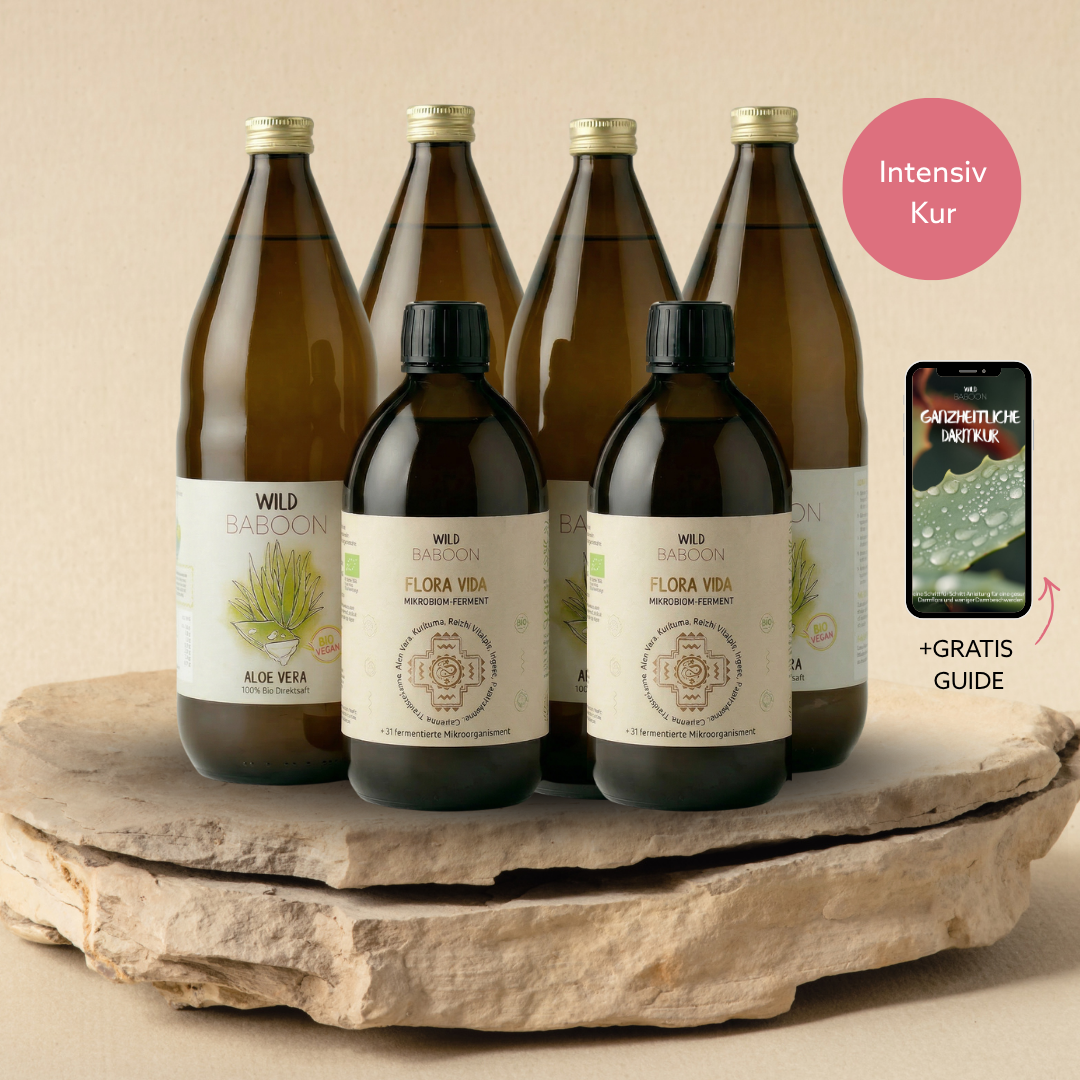
If you don't want that, you can resort to high-quality aloe products such as the Wild Baboon Aloe Vera Juice or the Wild Baboon Aloe Vera Gel.
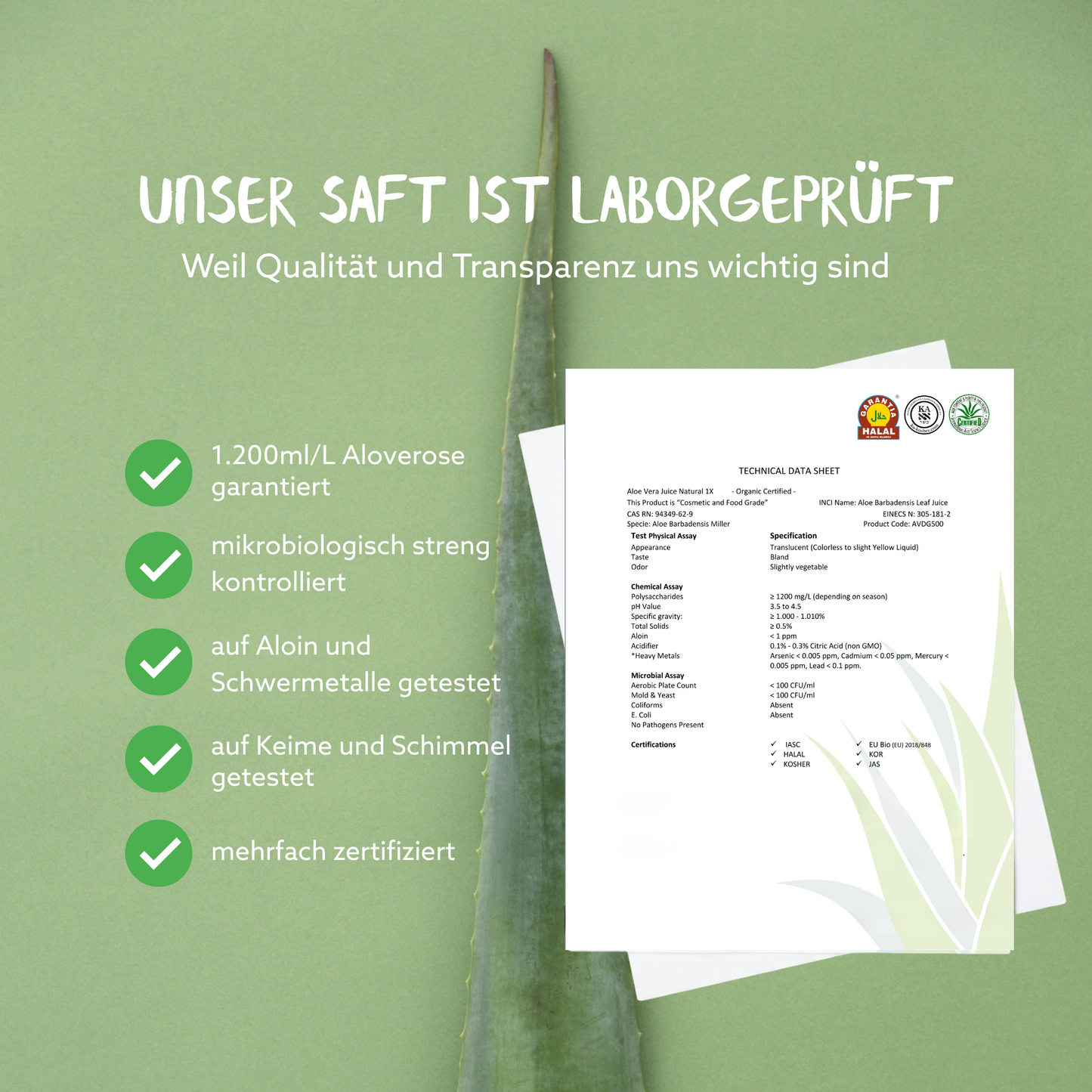
When purchasing high-quality Aloe Vera products, pay attention to these important factors to ensure effectiveness:
- High aloverose content of at least 1,200 mg per liter.
- No preservatives to avoid allergies.
- Aloin-free
- Grown in nutrient-rich soil so that all the plant's nutrients can develop.
- Sustainably produced so that the soil is not depleted.
Pests for Aloe Vera
Even though Aloe Vera is a very robust plant, it can occasionally be infested by pests. This can happen especially in conditions that are too cold or have stagnant air.
Typical pests include:
-
Mealybugs 🕷️
- Identifiable by white, cotton-like webs on the leaves or in the leaf axils.
- They suck plant sap and weaken the Aloe Vera.
- Solution: Remove with a cotton swab soaked in alcohol or soapy water, or treat with neem oil.
-
Spider mites 🕸️
- Appear as fine webs on the underside of leaves.
- Leaves appear dry or spotty.
- Solution: Increase humidity (e.g., by misting with water) or wipe with a soap solution.
-
Aphids 🪲
- Small green, black, or brown insects that attach to the leaves.
- Can weaken the plant and transmit diseases.
- Solution: Rinse off, spray with soapy water, or use natural predators like ladybugs.
-
Fungus gnats (larvae in the soil) 🪰
- Their larvae can damage roots if the soil is too wet.
- Solution: Let the soil dry out thoroughly, set up yellow sticky traps, or treat with nematodes.

Typical mistakes in caring for an Aloe Vera houseplant
Even though Aloe Vera is easy to care for, one or two mistakes can still be made. To prevent this from happening to you, here are the typical mistakes summarized:
- Watering too often
- Wrong soil
- Too little or too much sun
- Wrong temperature
- Waterlogging due to wrong pot
- Over-fertilization
- Incorrect watering (from above)
- Pots that are too small
FAQ - Your questions about the Aloe Vera houseplant
Is Aloe Vera poisonous?
The gel of the Aloe Vera is harmless and is frequently used in cosmetic and skincare products. However, the plant contains a yellowish sap (Aloin) beneath the leaf skin, which can have a laxative effect if consumed excessively. Therefore, raw Aloe Vera should only be consumed after thorough cleaning and proper preparation.
Can I make Aloe Vera gel myself?
Yes, you can. However, your homemade gel from Germany will probably not have the same nutritional values as a gel from a fully grown plant. In Mexico, for example, the plants grow under optimal conditions and can thus develop wonderful nutrient density. Therefore, it is worthwhile to rely on high-quality products that use the juice from Mexico and are also aloin-free.
What to do if Aloe Vera leaves turn brown?
If your Aloe Vera leaves turn brown, you should cut the leaves along the stem and dplace the Aloe Vera plant in a suitable location, avoid waterlogging, water moderately, and replace the soil if necessary.
How often should I water my Aloe Vera plant?
The water requirements of Aloe Vera are determined by location factors such as soil, light, temperature, and air circulation. Therefore, general recommendations such as watering once a day or twice a week are not accurate. It is advisable to check the soil moisture with your finger. If the top layer of soil is dry, the Aloe Vera medicinal plant is watered from below.
Is Aloe Vera a good houseplant?
Aloe Vera is the perfect houseplant because it is very easy to care for, requires little water, looks decorative, and also cleans your indoor air.
Where is the best place for an Aloe Vera plant?
A good location provides the Aloe Vera with plenty of light and is sufficiently heated. However, it should not be too sunny at the same time, as it could dry out otherwise. Therefore, gradually acclimatize it to stronger sunlight.
Why are my Aloe Vera leaves drooping?
If your Aloe Vera leaves are drooping, there could be several reasons. It is best to read our article to ensure that it is in a suitable location, you are watering it correctly, it has the right soil and no pests, and the room temperature is appropriate.
Can I plant Aloe Vera in normal potting soil?
Generally, you can use normal potting soil for your Aloe Vera plant, but cactus and succulent soil is better. Additionally, mix the soil with sand or seramis for increased soil permeability to prevent overwatering.
What does a healthy Aloe Vera look like?
A healthy Aloe Vera plant is intensely green and has firm, upright leaves. In addition, the leaf surface is smooth and free of pests, and the plant grows evenly.
Do you have an Aloe Vera plant or would you like to get one? Tell us about it in the comments!




1 comment
Vielen Dank für die Infos und hinweise und Ratschläge für die Pflege meiner heute gekauften Alovera.🤗