
Have you drunk aloe vera juice and suddenly experienced digestive problems, skin reactions, or general discomfort? Are these normal side effects? Or is it a so-called initial worsening?
Aloe Vera is a highly active medicinal plant that can initiate processes in the body. Depending on the dosage, individual starting condition, and product quality, various reactions can occur. In this article, you will learn what side effects are possible, how to classify them, and how to use Aloe Vera correctly.
Content
- Aloe Vera Juice: Side Effects, Initial Worsening & Correct Use
- Aloe Vera Juice Side Effects or Initial Worsening – What's the Difference?
- Possible Side Effects of Aloe Vera Juice
- What to do if side effects occur?
-
Why high-quality Aloe Vera is better tolerated
- Origin of Aloe Vera
- Aloin-free products
- No re-dilution or additives
- Aloverose content
- Wild Baboon Aloe Vera Direct Juice
- How to use Aloe Vera juice correctly: how to minimize side effects
Aloe Vera Juice: Side Effects, Initial Worsening & Correct Use
Aloe Vera juice can cause temporary reactions such as diarrhea, bloating, or skin reactions in some people, especially when first used. These side effects are often dose-dependent and not always a sign of a so-called initial worsening. It is crucial to correctly classify these reactions and adjust intake accordingly.
Aloe Vera Juice Side Effects or Initial Worsening – What's the Difference?
Not every reaction to Aloe Vera juice is automatically an initial worsening. Side effects often occur when the body reacts to an excessively high dosage, unsuitable product quality, or individual intolerance. Typical signs include persistent diarrhea, severe abdominal pain, or significant discomfort that does not improve after a short time.
An initial worsening, on the other hand, refers to temporary, mild reactions as metabolic or digestive processes adapt. This phase is time-limited and should subside after a few days. The distinction is important: if symptoms persist or worsen, it is usually not an initial worsening, but a signal to reduce, pause, or investigate the intake more closely.
Possible Side Effects of Aloe Vera Juice
Depending on the dosage, individual starting situation, and product quality, Aloe Vera juice can trigger various reactions. Possible side effects include:
- Diarrhea or loose stools
- Bloating and increased bowel activity
- Abdominal rumbling or mild abdominal pain
- Nausea
- Increased urination
- Rarely: allergic reaction
Important:
Side effects often occur when the starting dose is too high, intake is increased too quickly, or an inferior product is used. If symptoms persist or worsen, you should reduce, pause, or consult a doctor about your intake.
Our recommended dosage is 40 ml of organic aloe vera direct juice daily, morning and evening, on an empty stomach. This allows the nutrients to be absorbed optimally and prevents your body from being over-dosed. If you already know that you react sensitively, you can also start with a smaller amount.

What to do if side effects occur?
If side effects occur after taking Aloe Vera juice, it is important to remain calm and correctly assess your body's reaction. In many cases, discomfort can be reduced by simple adjustments:
- Reduce dosage: Side effects often arise from an excessively high initial dose. Significantly reduce the amount or discontinue the juice for one to two days and then start again with a smaller amount.
- Pause intake: If symptoms persist or feel significantly distressing, you should temporarily pause intake. Your body is indicating that it is currently overwhelmed or requires a different approach.
- Pay attention to the timing of intake: For sensitive stomachs, it may be advisable to take Aloe Vera juice with a small, easily digestible meal instead of on an empty stomach.
- Increase fluid intake: In case of diarrhea or increased bowel movements, it is important to drink enough water to balance fluid levels.
- Check product quality: Inferior Aloe Vera products with additives, heat processing, or low Aloe Vera content can promote side effects. Pay attention to purity, gentle processing, and transparent origin.
- Seek medical advice: If symptoms worsen, persist longer, or if there are pre-existing conditions or medication intake, medical clarification of the intake should be sought.
Aloe Vera juice should support the body, not burden it. Conscious, adapted use is crucial for the beneficial properties of the plant to be effectively utilized.
Why high-quality Aloe Vera is better tolerated
Not all Aloe Vera juice is the same, and this is where a crucial difference in tolerability lies. Many side effects are not caused by the Aloe Vera plant itself, but by inferior raw materials, incorrect processing, or undesirable plant components remaining in the juice.
Origin of Aloe Vera
Quality plays a central role as early as during harvesting. Aloe Vera plants should be at least 1.5 years old, ideally 3 to 5 years, for the valuable ingredients to fully develop. Equally important are the growing conditions: plants that grow year-round in optimal climate and nutrient-rich soils show a significantly higher density of active ingredients than Aloe Vera from houseplants or intensive mass production.
Aloin-free products
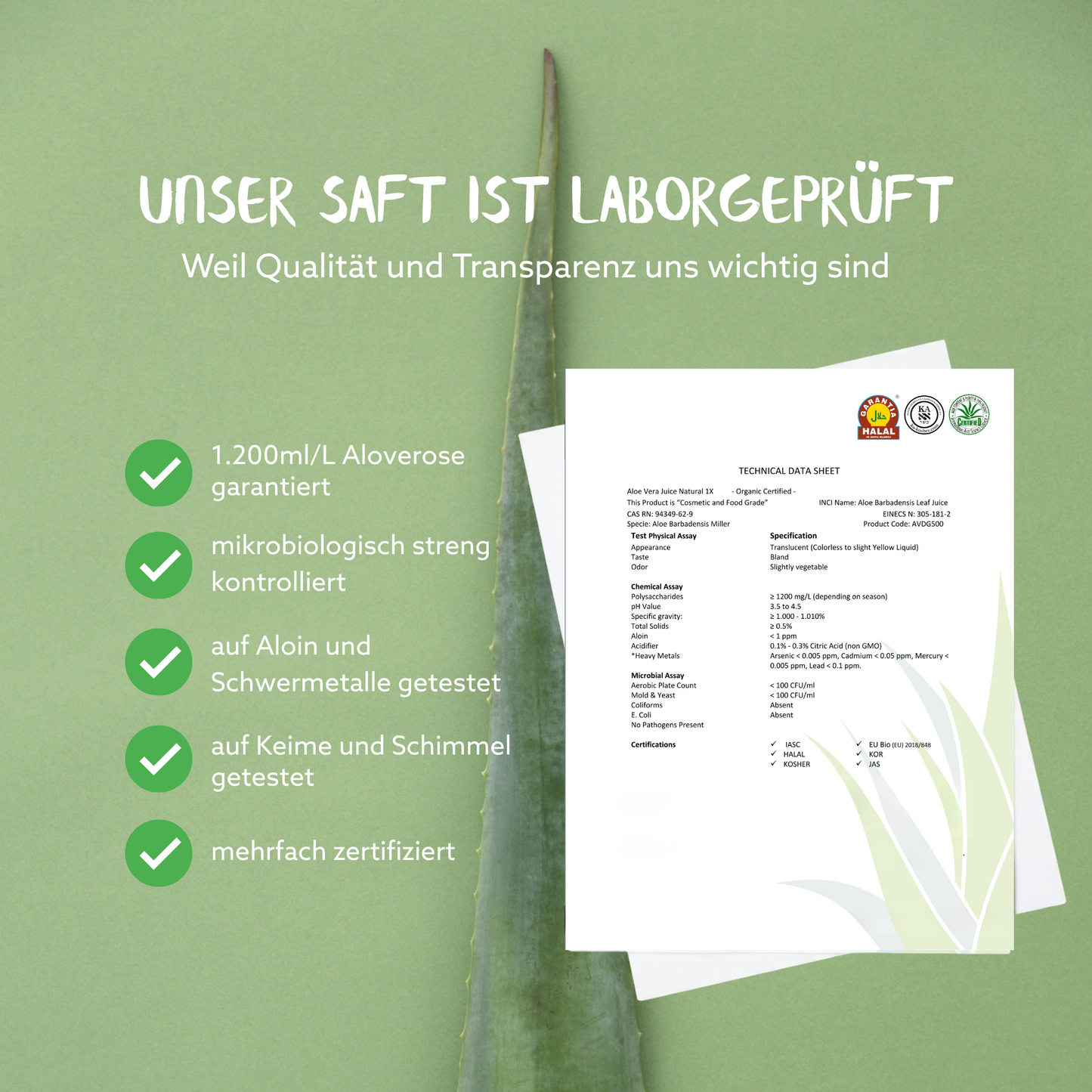
A particularly critical point is the removal of the substance aloin. This yellowish plant sap is located directly under the rind of the leaf and can lead to diarrhea, nausea, or abdominal cramps if not processed sufficiently. High-quality Aloe Vera products contain no aloin, just like our Aloe Vera juice.
With products in the EU, you generally don't have to worry, because according to EU regulations, aloin in Aloe Vera products may only be present in very small traces (≤ 1 mg/kg).
No re-dilution or additives
Furthermore, gentle processing is crucial. Aloe Vera contains sensitive ingredients such as mono- and polysaccharides (especially aloverose), amino acids, enzymes, as well as vitamins and trace elements. If these are altered by heat, re-dilution or additives, not only the quality but often also the tolerability suffers.
Aloverose Content
The polysaccharide aloverose or acemannan is the main ingredient of Aloe Vera, which in studies is associated with its valuable properties. A sufficiently high aloverose content is therefore an essential quality feature and a reason why high-quality Aloe Vera juice is generally better tolerated.
From an aloverose content of 1,200 mg/l, it is considered high quality. If the content is not specified on the bottle or is below this, you immediately know that it is not a high-quality juice.
Wild Baboon Aloe Vera Direct Juice
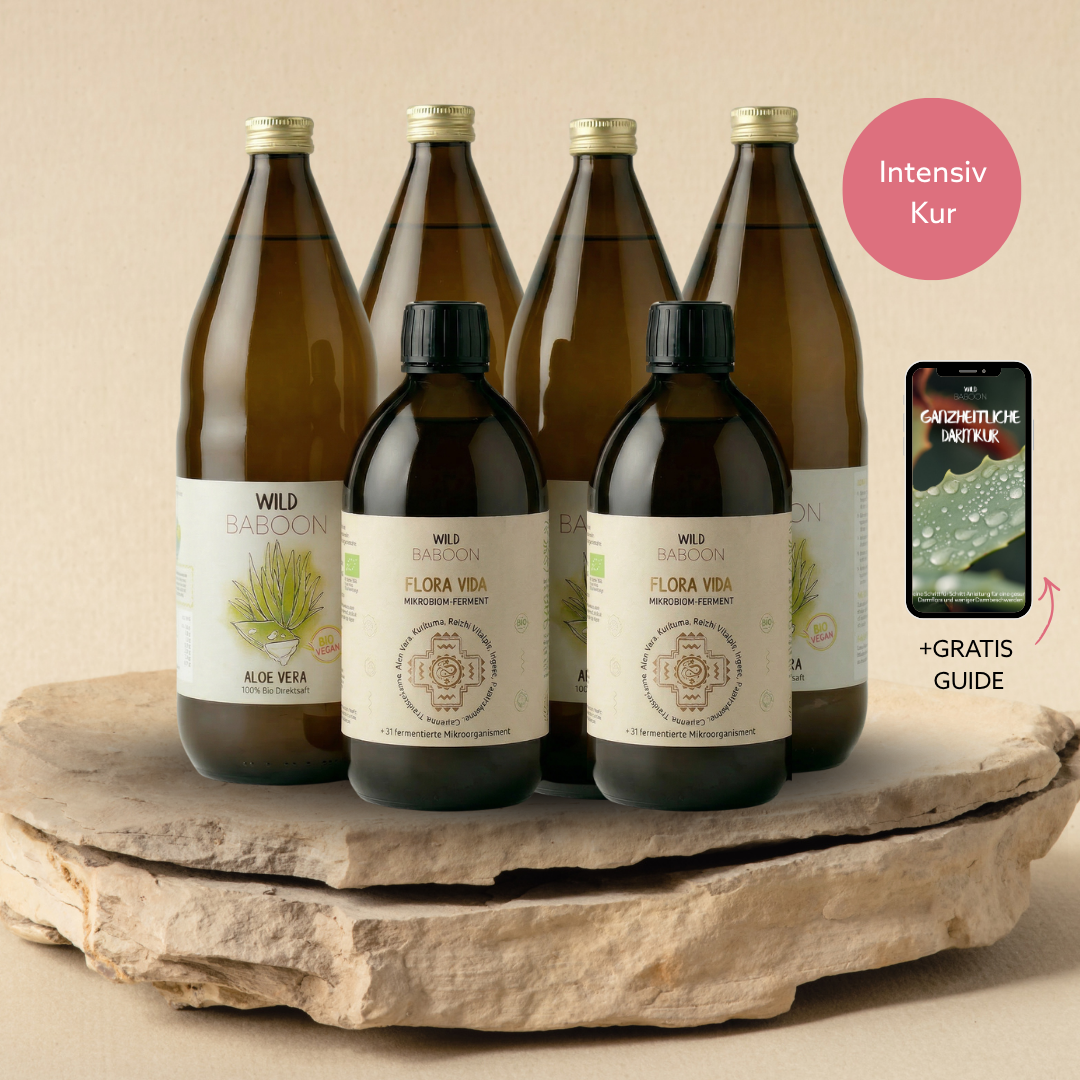
Our Aloe Vera juice comes from Mexico, where the plants grow under ideal climatic conditions. The juice is 100% pure, aloin-free, without re-dilution, without additives, and guarantees an aloverose content of at least 1,200 mg per liter.
This provides you with a high-quality Aloe Vera juice that minimizes side effects.

How to use Aloe Vera juice correctly: how to minimize side effects
- Start slowly: Begin with a small amount, especially if you are new to taking Aloe Vera juice. We recommend 40ml in the morning and evening as the optimal amount. Feel free to take a little less at the beginning.
- Increase dosage gradually: Only increase the amount when your body tolerates the juice well.
- Pay attention to the timing of intake: For sensitive stomachs, it's better to take it with a meal rather than on an empty stomach.
- Drink enough: Good hydration supports the body in processing.
-
Take body signals seriously: If discomfort occurs, reduce the dosage or take a break.
FAQ - Your questions about side effects and initial worsening of Aloe Vera juice
Can Aloe Vera juice have side effects?
Yes, Aloe Vera juice can cause side effects, especially with excessively high dosage, a sensitive digestive system, or inferior product quality. Common side effects include diarrhea, bloating, or abdominal rumbling. Generally, these symptoms are dose-dependent and temporary. It is important to adjust intake individually and pay attention to body signals.
Aloe Vera initial worsening: What does it mean and how long does it last?
Initial worsening refers to temporary, usually mild reactions that can occur as metabolic or digestive processes adjust. These include, for example, short-term skin changes or mild digestive reactions. This phase should only last a few days. If symptoms persist longer or worsen, it is usually not an initial worsening and a doctor should be consulted for advice.
Where can I buy Aloe Vera juice with a low risk of side effects?
A low risk of side effects primarily exists with high-quality, aloin-free Aloe Vera juice without additives or re-dilution. Transparent origin, gentle processing, and clear information on aloverose content are important. Products from controlled cultivation with guaranteed quality parameters are generally better tolerated than heavily processed mass products. The Wild Baboon Aloe Vera juice is a very high-quality organic product with at least 1,200 mg/l aloverose.
How do I know if it's side effects or an initial worsening?
Side effects are often stronger, persistent, or increase over time, whereas an initial worsening is mild and temporary. If symptoms improve after a few days or with a reduced dosage, it suggests an adaptation reaction. If symptoms persist, intake should be reviewed or paused.
When should you stop or pause Aloe Vera juice?
Aloe Vera juice should be paused if symptoms are severe, worsen, or persist for a long time. Medical clarification is also advisable for known pre-existing conditions, medication intake, or uncertainty. Aloe Vera should support the body, not burden it.