
Is your skin red, tight, and painful to the touch? Then you probably have sunburn! Your skin can get burned if it's exposed to too much sun and not properly protected. But what helps with sunburn? Here are the best home remedies!
What helps with sunburn? 🔥 Immediate Help Box
- Cool skin immediately (no ice, 10–20 min, 15-20°C water)
- Provide moisture (e.g., Aloe Vera Gel)
- Soothe inflammation
- Drink plenty of fluids
- Avoid the sun for at least 48h
Contents
- What is sunburn?
- What helps with sunburn?
- Tip 1: Act immediately
- Treating sunburn - Tip 2: Cooling
- First aid for sunburn: Drink plenty of fluids
- Tip 4: Natural home remedy Aloe Vera for sunburn
- Home remedies for sunburn
- What to do for severe sunburn?
- How long does sunburn last?
- How to prevent sunburn
- FAQ - Your questions about sunburn
What is sunburn?
Too much sun harms the skin. But what does "too much" mean? As you've probably noticed around you, some people get sunburned quickly, while others are spared longer. This is because each skin type can stay in the sun for different lengths of time before the skin reacts to sunlight.
Sunburn is caused by only one part of sunlight, the so-called ultraviolet radiation (UV radiation). It consists of UVA, UVB, and UVC rays, which we cannot see or feel. UVB radiation (280–315 nm) is responsible for sunburn and it is an acute inflammation of the skin. At this point, the cells have been damaged and possibly even killed.

What helps with sunburn?
Tip 1: Act immediately
No matter how careful you are, sometimes sunburn still occurs. The fastest help for sunburn is quick action to prevent it from getting worse! As soon as you notice that your skin is red, swollen, or itchy, you should immediately go into the shade. And you should stay there until your sunburn has completely subsided, otherwise, it can worsen. Avoid any sun exposure if you want your skin to recover quickly.

Treating sunburn - Tip 2: Cooling
Your body is overheated and needs to cool down as quickly as possible. The best thing would be a cool room or a cool shower. A water temperature of about 25 degrees is enough to cool your burned skin. You can also use moist compresses to cool your sunburn. Simply dip a clean cloth in cold water, carefully place it on the sunburn, and renew it when it warms up.
❗️But beware! Do not use ice cubes or ice packs for sunburn, as the already damaged skin cannot adequately protect itself from the strong cold. The irritation worsens and frostbite threatens.
First aid for sunburn - Tip 3: Drink plenty of fluids
With sunburn, the body loses a lot of water through the skin. Therefore, you should not only moisturize from the outside but also from the inside. Drink plenty of water or cool tea throughout the day.
Tip 4: Natural home remedy Aloe Vera for sunburn
The best natural and herbal home remedy for sunburn is Aloe Vera. Aloe Vera can support numerous bodily functions through the synergy of over 200 proven valuable nutrients such as vitamins, minerals, and amino acids, and therefore has an anti-inflammatory effect and soothes the skin.
If you have a mature Aloe Vera plant at home, you can cut off a leaf, halve it, and gently spread the gel on the sunburn. If you don't have a plant, you can simply use our Organic Aloe Vera Gel. It consists of 98.5% organic Aloe Vera and comes from our sustainable partner farm in Mexico.

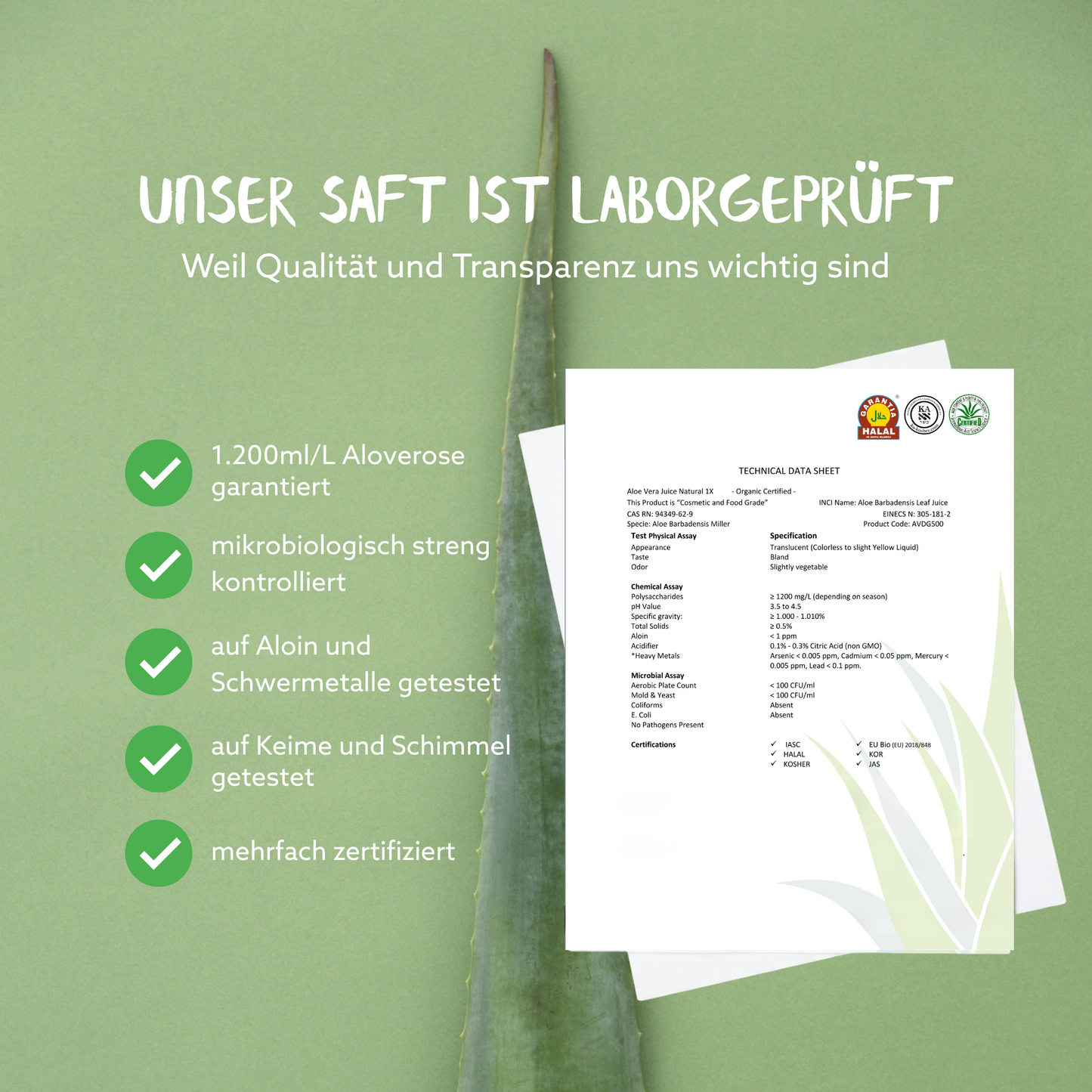
The most important ingredient in Aloe Vera is the so-called Aloverose, a polysaccharide also known as Acemannan. Aloverose, along with the other ingredients of the desert lily, is attributed healing properties that have been recognized and used for thousands of years.
It is a long molecular chain of combined sugar molecules, consisting of carbohydrates in conjunction with protein building blocks. The so-called proteoglycans connect human cells and are directly connected to connective tissue. Hyaluronic acid and collagen also bind to them and provide stability in the cell system. In addition, Aloverose promotes wound healing of the skin, as the active ingredient simultaneously accelerates cell division and the formation of new cells. Thus, you can use the Aloe Vera Gel preventatively as after-sun care, as it soothes your skin after sunbathing.
🤫 Tip: Store the Aloe Vera Gel in the refrigerator, as this will give it an even more cooling effect when applied, and use it as after-sun care after every sunbath.
Home remedies for sunburn
Aloe Vera (Gel)
- Effect: soothing, moisturizing, cooling
- Useful for: redness, tightness, mild inflammation
- Important: use pure and without alcohol/perfume, such as Wild Baboon's Aloe Vera Gel
Quark / Natural yogurt
- Effect: strongly cooling, removes heat from the skin
- Useful for: acute sensation of heat
- Important: only on intact skin, not on open wounds or blisters
Black tea (cooled)
- Effect: tannins have an astringent and irritation-relieving effect
- Useful for: itching and mild inflammation
- Application: compress for 10–15 minutes
Cool compresses (water)
- Effect: lower temperature, slow down inflammation
- Useful for: fresh sunburn
- Important: cool, not ice-cold (no ice directly on skin)
Cucumbers
- Effect: slightly cooling and moisturizing
- Useful for: face and sensitive skin areas
Oatmeal bath
- Effect: soothes irritated skin, reduces itching
- Useful for: widespread sunburn
Drink plenty of fluids (water)
- Effect: compensates for fluid loss
- Useful for: any sunburn (often underestimated)
What to do for severe sunburn?
You can't always treat sunburn with home remedies. Depending on its severity, you should consult a doctor. As soon as the sunburn forms blisters, you should be especially careful. In this case, it is a second or third-degree sunburn.
You should under no circumstances open the blisters yourself, as they can become infected. A third-degree sunburn is usually treated in the hospital, as there is a high risk of infection and those affected may need infusions due to severe fluid loss. In extreme cases, fever and severe headaches can even occur. Then you should definitely consult a doctor, as these symptoms are consequences of heatstroke or sunstroke.
How long does sunburn last?
If you've been in the sun for too long and unprotected, sunburn typically becomes noticeable after 3 to 6 hours with slight itching, burning, or tightness, as well as mild redness of the skin.
Especially the next day, it becomes more pronounced with strong redness, burning, and sometimes swollen skin. Depending on the severity of the sunburn, blistering, nausea, and headaches may also occur. Have you even gotten a very severe burn? Then your skin will start to peel and itch after about 3 days. As unpleasant as this is, it's a sign of the skin's healing process.
Typical symptoms of sunburn include:
- Redness
- Burning sensation
- Feeling of tightness
- Itching
- sometimes skin swelling
- possibly blistering
Symptoms reach their peak after 12-24 hours and then subside. Depending on the severity, sunburn can last up to 1-2 weeks.
How to prevent sunburn
It's best not to let it get to that point, because every sunburn increases the risk of skin cancer. Even after the sunburn has healed, consequences can remain. UV radiation can lead to permanent changes in the genetic material of skin cells. Some of these DNA damages persist and can lead to skin cancer later in life.
You can prevent sunburn by paying attention to the following points:
- ☀️ don't stay in the sun for too long
- 🧴 protect your skin with sunscreen
- 👚 protect your skin with clothing
- 🧴 don't be stingy when applying sunscreen and don't forget your nose, ears, feet, and shoulders
- 👒 protect your head (sunburn can also occur on the scalp)
- 🧴 ensure repeated application, because only repeated application helps against sunburn
- ☀️ On very hot days, you should avoid the midday sun between 11 am and 3 pm
- ⛱️ your skin needs to slowly get used to the sun after winter
❗️IMPORTANT: Coconut oil is not reliable sun protection! The oil has a sun protection factor of about 3-4, which means it offers minimal UV protection but is not sufficient to protect the skin from sunburn.

FAQ - Your questions about sunburn
When is sunburn dangerous?
Sunburn can be dangerous if it is particularly severe and many blisters have formed. In addition, every sunburn, whether severe or mild, increases the risk of skin cancer.
How long does it take for sunburn to disappear?
Depending on the severity, sunburn can last from a few days to 1-2 weeks.
Why do I get sunburn even with sunscreen?
If you've gotten a sunburn despite applying sunscreen, it could be because the sun protection factor (SPF) wasn't high enough or you didn't reapply it often enough. Especially after being in the water, you shouldn't forget to reapply.
How do I get rid of sunburn quickly?
Depending on how severely you've burned yourself, it can take longer for the sunburn to heal. All you can do to aid healing is prevent further burns, cool the affected areas, and regularly treat your skin with the natural home remedy Aloe Vera.
What helps fastest with sunburn?
The fastest help is immediate cooling:
- 10-20 minutes with cool (not ice-cold) water or compresses
- then moisturize (e.g., Aloe Vera Gel)
- consistently avoid the sun
Does sunburn get better overnight?
Unfortunately, this is usually not the case; it often becomes more visible after 6–12 hours. The inflammatory reaction is delayed. Redness and pain often reach their peak the next day and then slowly improve over several days. However, it depends on the severity of the sunburn. A very mild sunburn may be better by the next morning.
How do I get rid of sunburn redness?
The redness does not disappear immediately because it is part of the inflammation. You can soothe it faster by:
- regular cooling
- plenty of moisture (e.g. Aloe Vera Gel)
- drink enough fluids
- consistently avoid the sun
The less the skin is irritated, the faster the redness will subside.
Can sunburn itch?
Yes, itching often occurs during the healing phase, usually after 1–3 days. This is due to repair processes in the skin and the beginning of peeling. Cooling and moisturizing care (e.g. Aloe Vera Gel) usually help best.
When should you see a doctor for sunburn?
You should definitely see a doctor for sunburn if:
- blisters appear on larger areas of skin
- you develop a fever, chills, or nausea
- you have severe pain
- it is sunburn on children or infants
- you experience circulatory problems or headaches (possible sunstroke)
Author: Flora Sylka