
Aloe vera, also known as true aloe, is a fascinating plant that has been revered for thousands of years in various cultures for its health-promoting properties, and in some cases still is. This robust succulent, which thrives in dry and hot climates, is known for its thick, fleshy leaves that contain a valuable gel and juice.
The use of aloe vera dates back a long way. The ancient Egyptians called it the "plant of immortality" and used it for various purposes, from skin care to internal application. In traditional Chinese medicine and Ayurveda, it is still used to treat a variety of ailments, from digestive problems to skin diseases.

What are the benefits of aloe vera juice?
It may seem surprising that the juice of this desert plant can be drunk, and that you can benefit from its many special properties, such as improved nutrient absorption, reduced inflammation, and support for muscle regeneration.
Aloe vera juice has proven to be a valuable addition to a daily diet and fitness routine.
Discover the amazing health benefits of the aloe vera plant below, especially if you are passionate about sports: (We have summarized studies and sources for you further down)
-
Nutrient-rich: Aloe vera is known to contain a range of important vitamins (such as vitamins A, C, and E), minerals (such as potassium, calcium, magnesium, and zinc), and phytochemicals. These can supplement food to help meet the nutrient needs of athletes, stimulate cell renewal, and increase overall physical performance. In addition, aloe vera contains about 20 different amino acids, including 7 of the 8 essential amino acids that our body cannot produce itself and must therefore obtain from food. These essential amino acids are: isoleucine, leucine, lysine, methionine, phenylalanine, threonine, and valine. The non-essential amino acids are alanine, arginine, aspartic acid, glutamic acid, glycine, histidine, hydroxyproline, proline, serine, and tyrosine.
All these amino acids contribute to a variety of important functions in the body, including tissue building and repair, immune system support, energy production, and much more.
-
Improved digestion: Aloe vera has digestive properties. It can help improve digestion and thus optimize the absorption of nutrients. Efficient digestion and nutrient absorption are crucial for athletes, as they need an adequate supply of energy and building blocks for regeneration and growth.
-
Prebiotic properties: Aloe vera contains certain types of polysaccharides that can act as prebiotics. Prebiotics are nutrients that promote healthy gut bacteria, and they can help maintain a healthy gut flora and improve overall digestive health.
-
Hydration: Aloe vera juice consists partly of water, which is important for maintaining the body's fluid balance. During exercise, the body loses fluid through sweating, which must be replaced to prevent dehydration and resulting performance losses. In addition, aloe vera also contains electrolytes, which are important for maintaining fluid balance and muscle activity.
-
Anti-inflammatory: Acemannan, a compound found in aloe vera, is known for its anti-inflammatory properties. It can help reduce muscle and joint pain and shorten recovery time after intense training sessions. In addition, acemannan can reduce inflammation and irritation in the digestive tract, which can be particularly helpful for conditions such as irritable bowel syndrome or inflammatory bowel diseases.
-
Muscle regeneration: Acemannan has been shown to strengthen the immune system and support the body in tissue repair and growth. This can help promote muscle regeneration after strenuous exercise and improve the body's performance.
-
Blood sugar control: Some studies have shown that aloe vera can regulate blood sugar levels. This can help maintain energy levels during training and avoid a crash after training.
- Bioavailability: In addition, it has been found that aloe vera can improve the bioavailability of certain vitamins. In particular, studies have shown that the bioavailability of vitamin B12 is improved when taken with aloe vera. Vitamin B12 is particularly important for athletes, as it is essential for energy production and the general health of the nervous system.
(Important: Aloverose and Acemannan are two names for the same substance)
In summary, aloe vera can be an invaluable addition to the daily routine of any athlete. With its wide range of applications, from supporting hydration and improving nutrient absorption to reducing inflammation and supporting muscle regeneration, aloe vera meets a variety of needs that are important for optimal athletic performance and recovery.

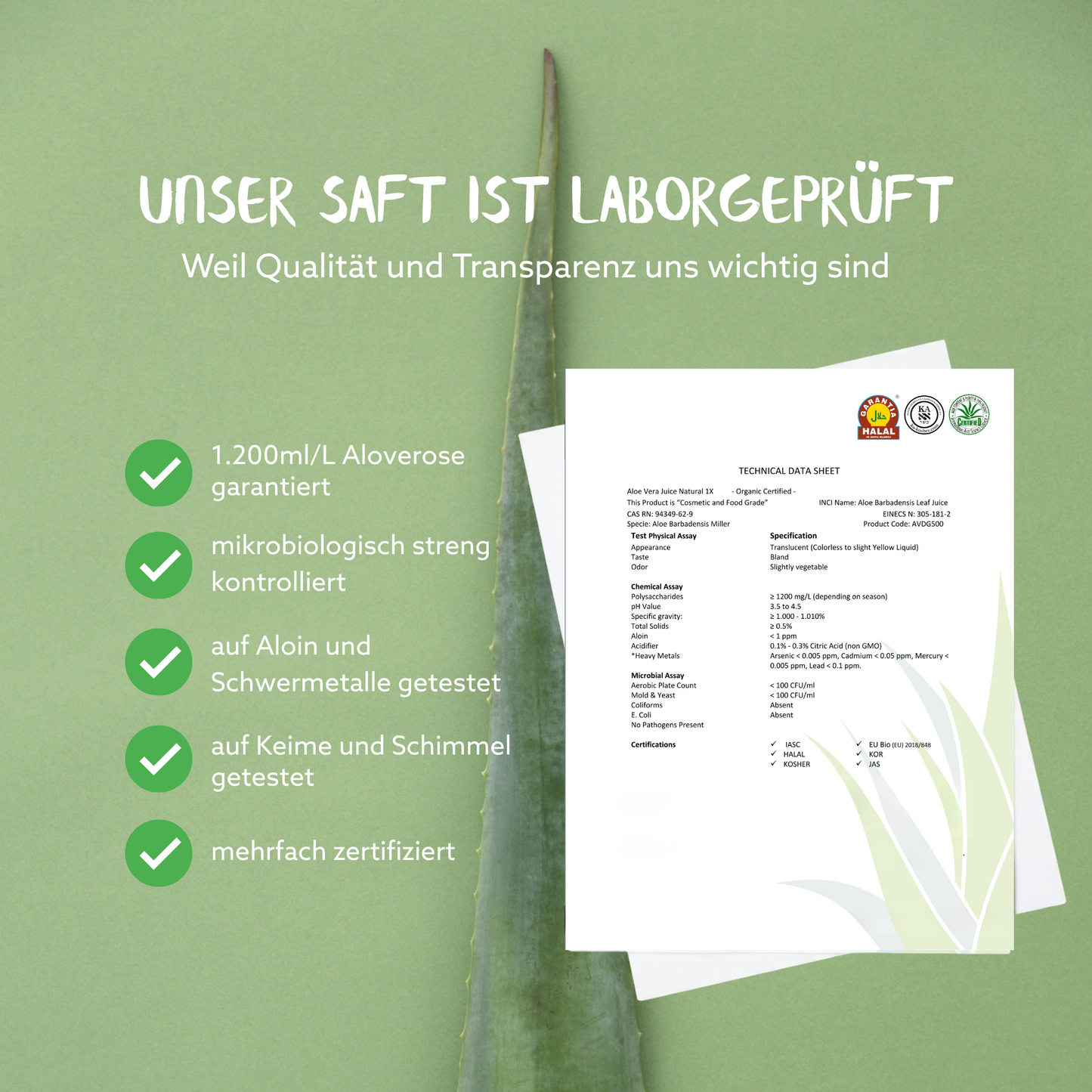
The organic aloe vera juice from Wild Baboon offers an excellent natural product thanks to its high content of aloverose/acemannan (at least 1200 mg per liter) from organic farming. This high concentration of acemannan can help athletes achieve their health and performance goals.

Choosing Wild Baboon's organic aloe vera direct juice is not only good for one's own health and fitness, but also for the planet and the people involved. The aloe vera plants used to produce the juice come from one of the most sustainable farms in the world in Mexico, where fertile soils and abundant sunshine contribute to the optimal development of the plants.

In addition to supporting their own health and performance, athletes who choose Wild Baboon also make a valuable contribution to promoting decent work in Mexico.
With every purchase of a Wild Baboon product, not only are fair working conditions for many people in Mexico supported, but also the three initiatives that Wild Baboon is committed to.
Therefore, the right choice can not only help athletes achieve their health and fitness goals, but also help make a positive impact on the world. Integrating aloe vera juice into one's daily routine is thus doubly beneficial - for the body and for the community.
be wild. be natural.
Sources:
Davis RH, Donato JJ, Hartman GM, Haas RC. Anti-inflammatory and wound healing activity of a growth substance in Aloe vera. J Am Podiatr Med Assoc. 1994 Feb;84(2):77-81.
Pugh N, Ross SA, ElSohly MA, Pasco DS. Characterization of Aloeride, a new high-molecular-weight polysaccharide from Aloe vera with potent immunostimulatory activity. J Agric Food Chem. 2001 Feb;49(2):1030-4.
Quezada, M. P., Salinas, C., Gotteland, M., & Cardemil, L. (2018). Acemannan and Fructans from Aloe vera (Aloe barbadensis Miller) Plants as Novel Prebiotics. J Agric Food Chem. https://pubs.acs.org/doi/10.1021/acs.jafc.7b04100
Radha, M. H., & Laxmipriya, N. P. (2015). Evaluation of biological properties and clinical effectiveness of Aloe vera: A systematic review. J Tradit Complement Med. https://pubmed.ncbi.nlm.nih.gov/31272819/
Ramamoorthy L, Tizard IR. Induction of apoptosis in a macrophage cell line RAW 264.7 by acemannan, a beta-(1,4)-acetylated mannan. Mol Pharmacol. 1998 Jun;53(6):415-21.
Tizard IR, Carpenter RH, McAnalley BH, Kemp MC. The biological activities of mannans and related complex carbohydrates. Mol Biother. 1989 Dec;1(6):290-6.
Vazquez B, Avila G, Segura D, Escalante B. Antiinflammatory activity of extracts from Aloe vera gel. J Ethnopharmacol. 1996 Dec;55(1):69-75.
Panahi, Y., Davoudi, S. M., Sahebkar, A., Beiraghdar, F., Dadjo, Y., Feizi, I., Amirchoopani, G., & Zamani, A. (2021). Chithra, P., Sajithlal, G. B., & Chandrakasan, G. (1998). Influence of Aloe vera on the healing of dermal wounds in diabetic rats. J Ethnopharmacol. https://pubmed.ncbi.nlm.nih.gov/19372635/
Kumar, V., Abbas, A. K., Fausto, N., & Aster, J. C. (2010). Robbins and Cotran Pathologic Basis of Disease, Professional Edition E-Book. Elsevier Health Sciences. https://pubmed.ncbi.nlm.nih.gov/23315202/
Thunyakitpisal, P., Chulasiri, M., & Nilkaeo, A. (2023). Acemannan stimulates gingival fibroblast proliferation; expressions of keratinocyte growth factor-1, vascular endothelial growth factor, and type I collagen; and wound healing. J Pharmacol Sci. https://pubmed.ncbi.nlm.nih.gov/35089010/
Kaithwas, G., & Majumdar, D. K. (2010). Evaluation of in vitro and in vivo wound healing potential of Aloe vera leaf extract and gel. J Chem Pharm Res. https://www.japsonline.com/admin/php/uploads/2174_pdf.pdf
Hamman, J. H. (2008). Composition and Applications of Aloe vera Leaf Gel. Molecules. https://www.ncbi.nlm.nih.gov/books/NBK92765/