
Green smoothies are considered a quick way to more energy, better digestion, and a nutrient-rich diet. However, many mixtures end up containing mostly sugar and provide significantly less health benefits than expected.
In this article, we show you what really makes a healthy green smoothie and which ingredients are crucial. You'll learn the simple basic rule for a balanced mixture and get five practical recipes that are filling, taste good, and effectively support your body.
Contents
- Basic Formula for Healthy Green Smoothies
- 5 Recipes for Healthy Green Smoothies
- Why Aloe Vera Belongs in Green Smoothies
- Benefits of Green Smoothies
- Green Smoothies and their History
- Why Many Smoothies are Unhealthy
- FAQ – Your Questions about Green Smoothies
What are Green Smoothies?
Green smoothies are blended drinks made primarily from fresh leafy greens (e.g., spinach, lamb's lettuce, or kale), a small amount of fruit, and a liquid such as water or plant-based milk. Unlike pure fruit smoothies, they contain significantly less sugar and provide fiber, phytochemicals, and micronutrients due to the leafy greens. The ratio of ingredients is crucial, as this is what makes a truly healthy green smoothie.
Basic Formula for Healthy Green Smoothies
- 1-2 handfuls of leafy greens
- 1 small portion of fruit
- Liquid according to consistency (preferably water or Aloe Vera Direct Juice)
- optional: 1 satiating/stabilizing component (e.g., flaxseed/chia/nut butter/oats)
According to the German Nutrition Society (DGE), healthy smoothies contain at least 50% vegetables. Green smoothies contain at least 50% leafy greens (or more) and 50% ripe fruits, which are blended with water. Furthermore, no sugar or other additives, nor isolated nutrients, should be added.
The ripe fruit makes the bitter taste of the leafy greens less noticeable, and the smoothie tastes delicious, even though more than half of it consists of leafy greens.
CAUTION: The ingredients, not the color, are important for green smoothies. Green powder combined with a banana smoothie, for example, would be far from a green smoothie, even though the color is still green.

Leafy Greens:
Suitable leafy greens for your green smoothie include kale, spinach, savoy cabbage, lettuce, carrot and kohlrabi leaves, or lamb's lettuce. They are rich in bitter compounds and antioxidants. Additionally, leafy greens have up to three times as much iron and magnesium and up to seven times as much vitamin C as the tubers themselves.
Especially for beginners, leafy greens with a very mild taste, such as spinach, are suitable.
Herbs:
Herbs are also perfect, as they are very rich in vital substances and often have a higher concentration of vital substances than common leafy greens. They also contain many vitamins and minerals. We recommend nettle, cilantro, peppermint, ground elder, cleavers, sorrel, dandelion, parsley, and chickweed.
Fruit:
When choosing fruit, it is very important to use ripe and fresh fruit, as it is sweeter, balances out the bitter taste better, and can also be digested more easily. Which fruit you choose is ultimately up to you. As a beginner, you can start with your favorite fruit to ensure you like it.
Liquid:
For adding liquid, water (still water), coconut water (not heated), or our Organic Aloe Vera Direct Juice are particularly suitable. You can find out more about this in the next point.
Spices:
If you wish, you can also add various spices that not only give your smoothie an interesting touch but also warm your body from within in winter. Many spices are also known for their health benefits.
Classics include ginger (antioxidant, anti-inflammatory, and digestive) or cinnamon (digestive and pain-relieving). Other spices you can try are cardamom, chili, turmeric, coriander, or pepper.
5 Recipes for Healthy Green Smoothies
We've put together 5 green smoothie recipes for you*. Enjoy!
1 ) Fresh Berry Smoothie*
Don't feel like a salad? To still get all the nutrients from Romaine lettuce and baby spinach, you can simply drink it as a smoothie. Even if the smoothie doesn't look like what you imagine a green smoothie to be, it's just as green and healthy as the other recipes and, most importantly, delicious!

Time: 5 minutes
Serving: 1 large glass
Ingredients:
- 1 apple
- 1 romaine lettuce
- 1 handful of baby spinach (40-50 g)
- 10 mint leaves
- 50 g blueberries
- 200 ml coconut water
- 50ml Aloe Vera Direct Juice
Preparation:
Blend everything in a mixer for about 1 minute until no chunks remain. Enjoy!
2 ) Detox Green Smoothie*
Do you want to start your day really healthy? The Green Detox Smoothie packs a punch and is probably only suitable for absolute smoothie experts. Nevertheless, it has an incredible amount of nutrients and no sugar, as it contains no fruit.
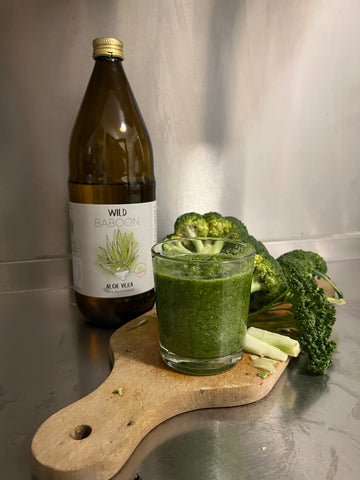
Time: 5 minutes
Serving: 1 large glass
Ingredients:
- 200 g leafy lettuce
- 1/2 bunch of parsley
- 400 g broccoli
- 50 ml Aloe Vera Direct Juice
- Water, if it's not liquid enough for you
Preparation:
Blend everything in a mixer for about 1 minute until no chunks remain. Enjoy!
3 ) Celery Sunrise Smoothie*
Celery juice is considered by many to be a particularly healthy juice. And not without reason – it is alkaline-forming, anti-inflammatory, and has a high content of vitamin K, which can strengthen your heart, among other things. Together with cucumber, parsley, and our Aloe Vera Direct Juice, you have a very healthy green smoothie.

Time: 5 minutes
Serving: 1 large glass
Ingredients for one drink:
- 1 cucumber
- 1 stalk of celery
- 2 tablespoons of Aloe Vera Direct Juice
- 1/2 bunch of parsley
- Water, if it's not liquid enough for you
Preparation:
Blend everything in a mixer for about 1 minute until no chunks remain. Enjoy!
4 ) Kale Boost Green Smoothie*
Kale is also considered an absolute superfood because it has a lot of calcium, iron, vitamin K and C. In addition, ginger is also very healthy and has anti-inflammatory properties, which are great especially in winter.

Time: 5 minutes
Serving: 1 large glass
Ingredients for one drink:
- 150 g kale
- 2 organic juice oranges
- 1 banana
- 10 g or 1 cm ginger
- 200 ml mineral water
- 50ml Aloe Vera Direct Juice
Preparation:
Blend everything in a mixer for about 1 minute until no chunks remain. Enjoy!
5 ) Cilantro Sour Green Smoothie
Heavy metals enter our bodies through the air and food, but also through fillings in our mouths, and can severely impair nerve function. What can you do about it? Cilantro is known for helping the body excrete heavy metals, and that's why we've created a special smoothie for it.

Time: 5 minutes
Serving: 1 large glass
Ingredients for one drink:
- 100ml water
- 7-8 stalks fresh cilantro
- Juice of half a lemon
- 30ml Aloe Vera Juice
- Half a golden kiwi
Preparation:
Blend everything in a mixer for about 1 minute until no chunks remain. Enjoy!
Why Aloe Vera Belongs in Green Smoothies
In addition to fruit and leafy greens, a smoothie also needs liquid for dilution. Water is best, but Aloe Vera plant juice can also be used.
The Aloe Vera plant is not only considered one of the oldest medicinal plants in the world, but also serves as an ideal supplement for a holistic, conscious, and healthy diet. Therefore, it fits perfectly into green smoothies.
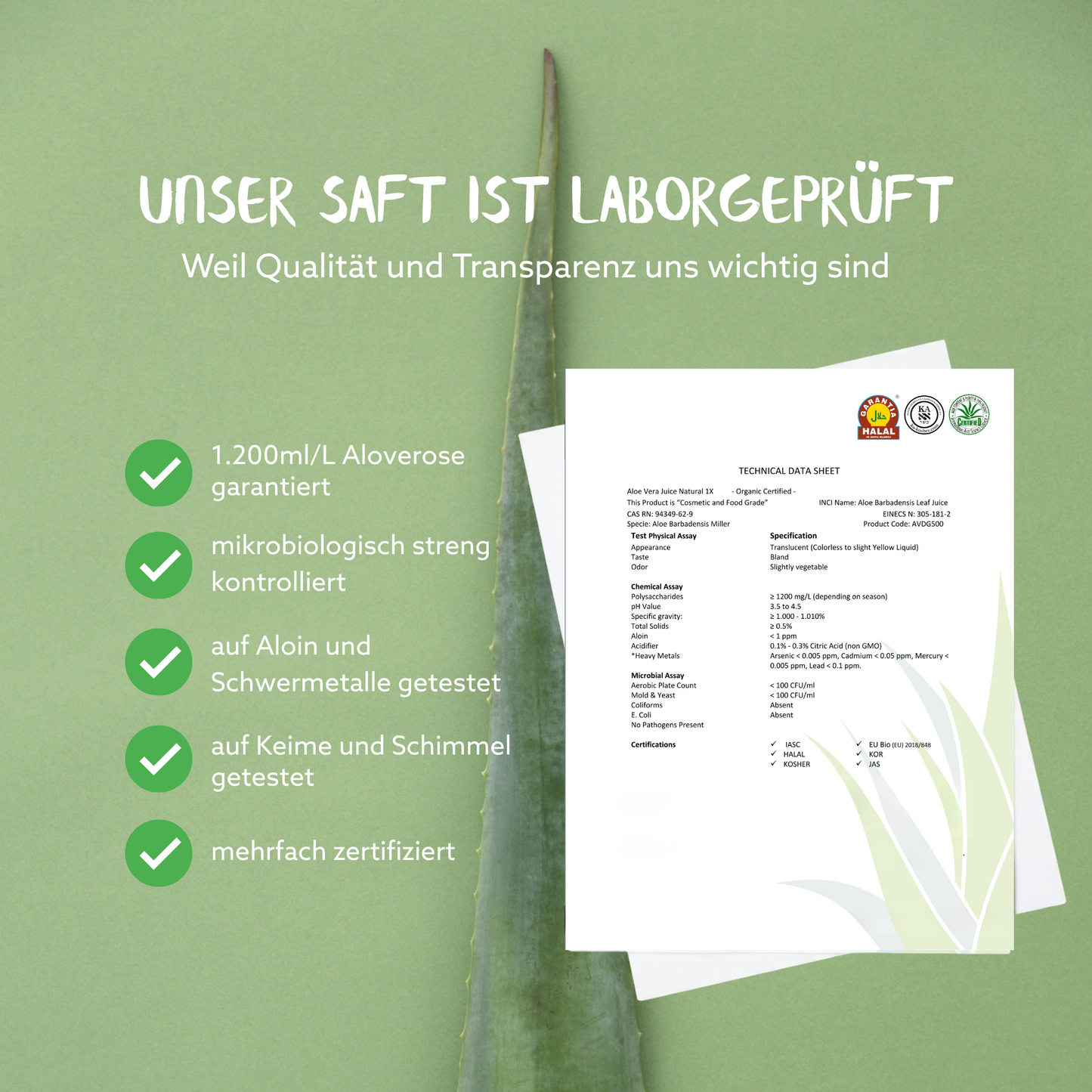
Aloverose is an important component of Aloe Vera and one of the main reasons for its status as a medicinal plant. The higher the aloverose content, the higher the concentration of active ingredients. Generally, an aloverose content of 1200mg/l is considered very good quality.
For Wild Baboon Aloe Vera Juice, we guarantee at least this content, and depending on the harvest and season, even more. You can read about all the benefits of the Aloe Vera plant and why you should incorporate Aloe Vera juice into your diet here.

Benefits of Green Smoothies
Green smoothies don't just look healthy; they actually offer many health benefits and are, for good reason, the only truly healthy smoothies. Here's what benefits green smoothies bring to your body:
1. Green Smoothies are Easily Digestible
Do you wonder why you fall into a midday slump and feel incredibly tired after a large lunch? That's because your digestion requires a lot of energy and is very complex.
Since the ingredients of green smoothies are finely chopped by blending, your body has less work later. This saves energy, and we feel less tired after a green smoothie. In addition, the nutrients in green smoothies stimulate digestion and promote a healthy gut flora, just like the addition of water.
2. Green Smoothies Strengthen the Immune System
A healthy gut flora also has a positive effect on your immune system. In addition, the many minerals, vitamins, trace elements, and phytochemicals strengthen your body. Especially in winter, green smoothies are a great addition to your diet.
3. Green Smoothies Have an Anti-Aging Effect
If you've spent years trying various anti-aging creams without success, you should try green smoothies instead. Not only are they delicious, easy to digest, and can replace a meal, but they also counteract skin aging. Thanks to the many antioxidants, vitamin C, vitamin E, and beta-carotene in green leafy vegetables, cell damage can be compensated for and the natural aging process can be slowed down.
By adding certain ingredients known for their anti-aging effects, you can further protect your skin. These include, for example, coconut water, which reduces wrinkle formation through kinetin and also provides moisture. But spinach and lemons are also excellent in a green anti-aging smoothie.
4. Green smoothies make your skin glow
Aside from the anti-aging effect, green smoothies have other benefits for your skin. The omega-3 fatty acids, in particular, ensure a radiant complexion, but vitamins, especially vitamin C, are also beneficial for collagen production.

5. Green smoothies support detoxification
The many fiber in green smoothies support your body's detoxification by absorbing toxins in the intestines and then eliminating them from the body. This can improve your well-being and also make us look younger.
6. Green smoothies have many nutrients
Whether fiber, proteins, minerals, vitamins, or trace elements – all are contained in green smoothies, as green leafy vegetables are particularly nutrient-rich. Mixing them releases the nutrients, making them easier for the body to absorb and digest. On the other hand, you can consume vegetables and fruits raw, preserving their vital substances.
7. Green smoothies can prevent diseases
Victoria Boutenko invented the green smoothie primarily for one reason: she wanted to alleviate her family's health problems – with success. In addition to the aforementioned benefits, such as improved gut flora, a stronger immune system, and detoxification of the body, green smoothies can also prevent heart attacks, strokes, or rheumatic diseases. In particular, secondary plant compounds and chlorophyll in leafy greens can prevent diseases, with chlorophyll also improving blood count, preventing cancer, and fighting bacteria or fungi.
8. Green smoothies are alkaline-forming
Did you know that an acidification of the body can be partly responsible for your body's health problems? Acidification can be caused, for example, by many animal foods, coffee, sugar, alcohol, and nicotine. Here too, green smoothies can help or act preventively, because they are alkaline-forming. Fruits and green leafy vegetables are among the alkaline foods and stabilize the acid-base balance in the body in case of acidification.
Green Smoothies and their History
Green smoothies were invented in 2004 by Russian Victoria Boutenko. At that time, her entire family suffered from various health problems such as rheumatoid arthritis, progressive hyperthyroidism, heart disease, asthma, and type 1 diabetes.
Initially, she switched the family's diet to a raw food diet, which indeed alleviated their symptoms. After a few years, Victoria realized that while their diet was healthy, it wasn't balanced enough. An important component of a healthy diet was missing – leafy vegetables.
The problem: The whole family simply didn't like the taste. Inspired by the eating habits of chimpanzees, who always ate their leaves and plants together with fruits, an idea came to her. She blended leafy vegetables with fruits and a small amount of water, which was the birth of the first green smoothie.
Victoria and her family now live in the USA, she has written two books about green smoothies, and gives lectures worldwide on green smoothies and their health benefits.

Why Many Smoothies Are Unhealthy
There are 2 reasons why most smoothies are unhealthy:
- The sugar content in smoothies
- The amount of fruit in smoothies

High Sugar Content in Smoothies
Smoothies (= pureed fruit juices) often contain more sugar than a cola.
For comparison: One liter of cola contains 35 sugar cubes, which is equivalent to 106 g of sugar. While this is a lot, smoothies can contain up to 15 g of sugar per 100 ml. This would be 150 g of sugar per liter, almost 50 g more than the same amount of cola!
Thus, both one liter of cola and one liter of smoothie far exceed the World Health Organization's recommended maximum of 25 g of sugar per day. Even if you only drink half a liter of smoothie or even just 0.33 liters, you exceed the maximum or have already met your daily requirement.
Of course, here we also have to differentiate between types of sugar, because cola contains industrial sugar and fruit contains fructose, which is generally considered healthier. But that brings us to the next myth.
Fructose in regular large quantities (as in a daily smoothie) can be harmful to the body. The liver, in particular, can be damaged, because too much fructose negatively affects the function of mitochondria, which impairs fat burning. This means the liver has to store more fat and can become a fatty liver.
A fatty liver has far-reaching consequences; for example, the hormone insulin, which lowers blood sugar and is therefore important for metabolism, is disrupted. In addition, the risk of liver inflammation and liver cancer, as well as high blood pressure, heart and vascular diseases, increases. There is also an increased risk of developing type 2 diabetes.
High amount of fruit in smoothies
The second problem with smoothies is the large amount of fruit. Often, all sorts of fruits are thrown into the blender without realizing how much it actually is. In most cases, you would hardly manage to eat the same amount of fruit as a whole fruit. Therefore, when preparing a smoothie, it is important to ask yourself if you could eat the amount of fruit in the blender as is.
More fruit also means more fructose. In addition, it would take much longer to eat the same amount of fruit. With a smoothie, a large amount of fruit, as well as a large amount of fructose, enters your body and organs in a matter of seconds.
Moreover, the blending process destroys the cell structures of the accompanying substances, which are actually the healthiest components of the fruit and help you stay full longer.
IMPORTANT: Fruit is and remains healthy. An occasional smoothie is also fine, ideally freshly made at home so you can control the quantities. However, fruit is best in its solid state so that all nutrients can be slowly absorbed into your body and you stay full for a long time.
The German Nutrition Society (DGE) confirms that smoothies should only be incorporated into a healthy diet if they consist of fresh fruits and vegetables, contain 200-250 ml, and are consumed only occasionally.

FAQ – your questions about green smoothies
Are green smoothies really that healthy?
Yes, green smoothies are healthy. Whether fiber, proteins, minerals, vitamins, or trace elements – all are contained in green smoothies, as green leafy vegetables are particularly nutrient-rich. In addition, they contain no added sugar and a low amount of sugar overall, as they contain more vegetables than fruit.
What doesn't belong in a green smoothie?
Sugar and sweeteners are taboo! The same goes for dairy products, grains, or legumes. Also, carbonated water should not be used as a liquid.
How often should you drink a green smoothie?
Once a day and preferably in the morning on an empty stomach is optimal. However, make sure not to drink the same smoothie every day, but to rotate the fruits and leafy greens.
What is a green smoothie good for?
Green smoothies have many benefits. They can help to prevent diseases, consume more nutrients, or achieve better skin. You can read all the benefits in our article.
How long after a green smoothie should I not eat anything?
For optimal nutrient absorption, you should wait half an hour before eating anything after your smoothie. This is enough time for it to digest, especially if you drank it on an empty stomach.
Can you drink a green smoothie every day?
Yes, you can! But make sure not to drink the same smoothie every time; instead, switch up the fruits and leafy greens.
Which smoothie is the healthiest?
Green smoothies are the healthiest smoothies because they contain only small amounts of sugar but many nutrients from the leafy greens.
Can you also drink green smoothies in the evening?
You can drink green smoothies at lunchtime or in the evening. However, make sure that enough time has passed since your previous meal. Green smoothies are more easily digestible and could otherwise mix with the food from your meal in the gastrointestinal tract, which would impair digestion.
In general, however, many tolerate green smoothies best in the morning, as the body can absorb the nutrients well and the digestive tract is active.
What vegetables should I use for green smoothies?
Suitable leafy vegetables for your green smoothie include cabbage, spinach, savoy cabbage, lettuce, carrot and kohlrabi leaves, or lamb's lettuce. They are rich in bitter substances and antioxidants. In addition, leafy vegetables have up to three times as much iron and magnesium and up to seven times as much vitamin C as the tubers themselves.
How much fruit belongs in a green smoothie?
A green smoothie should primarily consist of leafy greens. About one portion of fruit to one or two handfuls of leafy greens has proven effective. This keeps the taste pleasant without the smoothie becoming a fructose bomb.
Why do I get bloating after green smoothies?
Bloating often occurs when the gut is not used to large amounts of raw fiber. Especially at the beginning, many people react sensitively to leafy vegetables or large portions. Smaller amounts, thorough blending, and easily digestible varieties like lamb's lettuce or baby spinach help the body get used to it.
Do green smoothies make you full or just give you short-term energy?
That depends on the composition. A green smoothie made only from fruit provides quick energy but little satiety. If it also contains fiber and a fat or protein source like nut butter, seeds, or oatmeal, blood sugar remains more stable and satiety lasts significantly longer.
Why does my green smoothie taste bitter?
Bitterness usually comes from too much strong leafy greens like kale or arugula. A small amount of mild fruit, ripe banana, or some fat like nut butter can balance the taste without making the smoothie too sweet.
*Our smoothies are inspired by Allgäukind