
As the annual Christian Lenten season between Ash Wednesday and Easter begins, you might consider giving up sweets or abstaining from meat during this time. But did you know that fasting is much more than just abstinence? In many cases, it not only has a religious background but also a health-related one. In this blog post, you'll learn why fasting is so healthy and what methods exist.
Contents
- Why is fasting healthy?
- Fasting as a natural process
- What to consider when fasting
- Who can fast?
- Where should one fast?
- Further tips
- What types of fasting are there?
- Water fasting and the zero-calorie diet
- Juice fasting: Through a juice cleanse with fruit and vegetable juices
- Therapeutic fasting according to Buchinger
- Detoxification through alkaline fasting
- Intermittent fasting: 16:8, 5:2 and 1:1 method
- Fasting with Aloe Vera
- The fasting checklist
- FAQ – Your questions
Why is fasting healthy?
Fasting means abstinence. Abstaining from food, certain foods and stimulants like sweets or alcohol with the goal of relieving your own body. Depending on the method, this can last for hours or over several days or weeks.
Giving up sweets makes logical sense, because as everyone knows, sweets are full of sugar and not healthy. But what does complete abstinence from food bring?
Our digestion consumes about one third of our daily energy. This is a lot, considering that our body also needs energy for all basic life-sustaining functions. These include many bodily functions that we are not even consciously aware of, such as our heartbeat, our breathing, our brain activity, or the stabilization of our body temperature. In addition, the body needs energy for our muscles, which enables us to move as we wish.
If you abstain from food, the body does not have to digest anything and therefore has more energy available, which can be used in other areas. This is evident in the example of a top athlete:
Before a competition, they often remain sober or eat only easily digestible foods, so that the body does not have to expend any or hardly any energy on digestion. This has the advantage that they have more energy left for athletic activities and can therefore perform better.
During fasting, the additional energy can be used for various cleansing functions of the body. This includes, for example, the removal of "metabolic waste" or the physical and mental cleansing of harmful toxins, as well as the acceleration of the body's healing processes.
Fasting as a natural process
Many people know fasting from the major world religions such as Christianity, Buddhism, Hinduism, Islam, or Judaism. There, it is used for spiritual, mental, and physical purification. But even in many diets or weight loss plans, abstaining from certain foods or solid food is well-known and popular.
However, fasting is not an invention of fitness experts or religious thinkers. It is a natural process of the body that each of us experiences unconsciously every day. Every day we are active, eat, digest, think, and move. As soon as we fall asleep, consciousness is switched off and the body uses this time for the breakdown, remodeling, and building up of our body – the healing processes. During our night's rest, we also do not consume any food and fast.

Furthermore, conscious fasting has always been an integral part of life for various isolated peoples. An example is the Hunza people from the Himalayas (Book "Wie neugeboren durch Fasten" by Dr. med. Hellmut Lützner). As self-sufficient people, they did not have access to food all year round and had to fast for some time during the winter.
With the connection to civilization, sugar, wheat, and canned goods were imported, and the people were no longer dependent on abstaining from food. But with this supposed progress, the so-called "diseases of civilization" also began. Due to obesity, gallbladder problems, tooth decay, diabetes, and colds, they were now dependent on doctors.
Even in the animal kingdom, fasting is a natural process, and many animals fast every winter. The Emperor Penguin, in particular, is a true expert in this field. It can go without food for up to 4 months in icy cold. During the breeding season, it feeds only on its own body fat reserves, while sparing its protein reserves. This allows it to easily dive back into the water after the fasting period and hunt for new prey.

What to consider when fasting
Fasting can be very healthy for your body, but it should still be done with caution and is not suitable for everyone.
Who can fast?
Especially pregnant women should only fast after pregnancy, as it is still unclear how the toxins released and excreted by abstaining from solid food can affect the unborn child. Furthermore, only generally healthy people should fast. If you regularly take medication or your health status is unclear, you should definitely consult a doctor beforehand.
Furthermore, it is not recommended for people over 65, children under 16, underweight individuals, or people with eating disorders.
Where should one fast?
The location where you carry out your fasting cure should be individually tailored to your needs. It is important that you feel comfortable there and can avoid stress. A quiet retreat, such as your own home and a place where you can keep yourself busy, is ideal for this. If you don't live alone, you should discuss with your family, friends, or roommates that you want to fast and why. This way, they can give you the space you need.
Another option is a beautiful holiday home in nature, where the triggers of your natural environment are not present, and you can focus 100% on fasting.

Further tips
Here's a brief summary of everything else you should consider during your fasting cure:
- Drink plenty! (3-4 liters a day)
- Start slowly and transition back slowly
- Plan relaxation into your day
- Exercise and activities you enjoy, like reading or painting
- Digital detox
- Rest!
- Empty your bowels at the beginning with enemas or alternatively proven methods
What types of fasting are there?
There are now countless types of fasting, and it can be quite confusing, especially for beginners, to find the individually suitable method.
Ultimately, what you choose depends on your physical condition and your set goal. Therefore, we have summarized the 5 most popular methods for you here and also present another method.
1. Water fasting and the zero-calorie diet
At a glance:
- Suitable for: healthy professionals
- Duration: maximum two weeks
- Food/Liquid: water only
Let's start directly with one of the toughest fasting methods: water fasting. As the name suggests, all forms of food intake are abstained from, and only still water or mineral water is consumed. Since no calories are consumed, this type of fasting is also referred to as a zero-calorie diet.
It is important to drink at least 3 liters a day and not to stop eating from one day to the next. It's best to start a few days beforehand by reducing calories and food, and also consume only easily digestible food. As with many types of fasting, you should also empty your bowels on the first day.
Since water fasting is very radical, you should preferably discuss your plans with a doctor first and carry out this method for a maximum of two weeks. Always listen to your body and do what feels good for you.
2. Juice fasting: Through a juice cleanse with fruit and vegetable juices
At a glance:
- Suitable for: beginners
- Duration: between 2-7 days
- Food/Liquid: fruit and vegetable juices, water, herbal teas, vegetable broth
Although juice fasting also involves abstaining from solid food, it is not a zero-calorie diet. This allows your digestion to rest, but you still consume calories and nutrients such as vitamins and minerals. However, the daily calories are still below your usual daily intake, meaning your body has to draw on other energy reserves.
A juice cleanse usually lasts between 2 and 7 days, depending on how advanced you are. Primarily, various fruit and vegetable juices are allowed, to be drunk 3-5 times a day. In total, you should aim for about 1.5 liters. Additionally, water, herbal teas, and clear vegetable broths are permitted, and you should drink about 3 liters of these.
When preparing juice, you should aim for a higher vegetable-to-fruit ratio, as you might otherwise consume too much fructose. If you're looking for inspiration for delicious green smoothies with aloe vera juice, you can check out our recipes here. Feel free to add more liquid to these recipes to make them juice-like.
Furthermore, you should make sure to drink your juices slowly and always listen to your body.
3. Therapeutic fasting according to Buchinger
At a glance:
- Suitable for: advanced
- Duration: 7-10 days + preparation and post-fasting
- Food/Liquid: teas, juices, vegetable broths, water, honey, dairy products
Therapeutic fasting is a tradition spanning millennia for the cleansing and regeneration of the body. The most well-known form today is Buchinger therapeutic fasting, named after the German physician and naturopath Otto Buchinger (1878-1966). This method is intended to activate the body's self-healing powers and help with illnesses.
The German Medical Association for Therapeutic Fasting and Nutrition (ÄGHE) recommends 7-10 days, plus a preparation day and 3 post-fasting days. It is best to start the preparation with easily digestible foods such as vegetable soups or porridge. On the first day, you should empty your bowels and then abstain from solid food for the entire period.
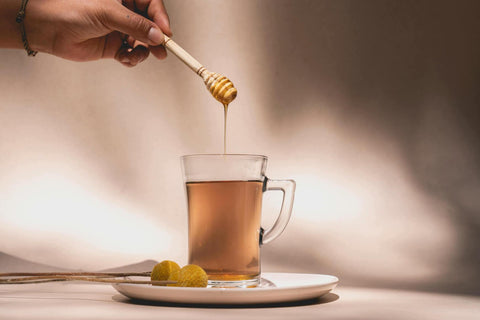
Particularly important in Buchinger therapeutic fasting is an adequate fluid intake of at least 2-3 liters per day. Water, vegetable broth, herbal teas (with honey), and juices are allowed. In addition, dairy products are allowed in small quantities, so you can consume about 200 g of quark, yogurt, or milk daily.
You end your fast with the so-called "breaking the fast". Light, low-calorie foods are recommended at first so that the body can get used to solid food again. An ovo-lacto-vegetarian diet, commonly understood as vegetarian, is particularly suitable for this.
4. De-acidification through alkaline fasting
At a glance:
- Suitable for: everyone/beginners
- Duration: 1-2 weeks
- Food/liquid: purely alkaline foods
Alkaline fasting is one of the mildest and simplest forms of fasting, as you still consume food daily. This consists of purely alkaline or alkaline-forming foods such as fruits, vegetables, herbs, salads, potatoes, sprouts, and a few other foods like tiger nut flakes. However, you don't have to eat these raw and individually; you can prepare delicious salads, stews, or mueslis from them. You can find delicious green smoothie recipes here.
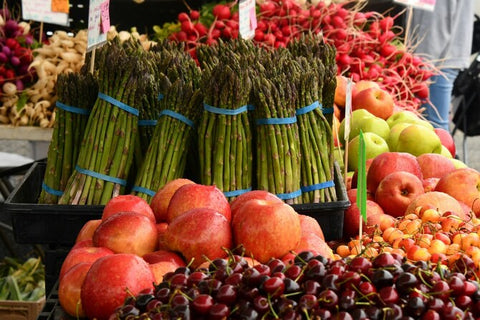
Since acid-forming foods are completely avoided here, the body can be de-acidified and its natural acid-base balance restored. The natural pH value varies depending on the body region; for example, blood is slightly alkaline, while the stomach is acidic.
Did you know that an over-acidification of the body can sometimes be responsible for your body's health problems? Over-acidification can be caused by many animal foods, coffee, sugar, alcohol, and nicotine, for example.
Regular de-acidification through alkaline fasting can counteract this, relieve your body, and alleviate symptoms. Furthermore, unlike other variants, alkaline fasting is suitable for everyone and can therefore also be carried out by people with chronic diseases such as migraines, constipation, or autoimmune diseases.
A study by Gerry K. Schwalfenberg (2012) investigated whether an alkaline diet promotes health. He concluded that an increased proportion of fruit and vegetables in an alkaline diet can improve the sodium/potassium ratio (ideal: 1:1). Sodium and potassium are important for the function of the nervous system, balanced blood pressure, and our muscle function.
In addition, this form of nutrition can positively affect bone health, and chronic diseases such as high blood pressure or strokes are said to improve.
5. Intermittent Fasting: 16:8, 5:2 and 1:1 Method
At a glance:
- Suitable for: disciplined long-term fasters
- Duration: longer-term, limited to specific periods
- Food/liquid: only water and herbal teas
16:8, 5:2, or 1:1 are not math problems, but rather different variants of intermittent fasting (also called periodic fasting). This involves abstaining from all types of food or liquid, except water and herbal teas, for a specific period. This period varies depending on the method:
- 16:8 Method: You fast for 16 hours every night, then you can consume meals over an 8-hour period.
- 5:2 Method: Here, the period is viewed weekly. You eat normally on 5 days of the week, and on the other 2 days (for example, on the weekend), you drastically reduce your calorie intake.
- 1:1 Method: Here, you alternate eating normally on one day and consuming only 25% of your usual calorie intake on the next.
Compared to other methods, intermittent fasting is a long-term eating and lifestyle approach, not a short-term exception. Adequate fluid intake, even during fasting, and a balanced diet are also important here. Furthermore, it is advisable to take several hours of breaks between meals to keep blood sugar levels stable.
But: So far, the health benefits of intermittent fasting have not been sufficiently proven, and research results are not conclusive.
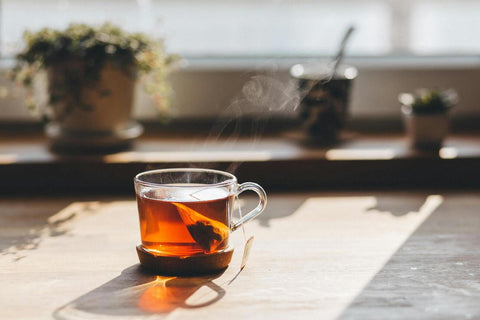
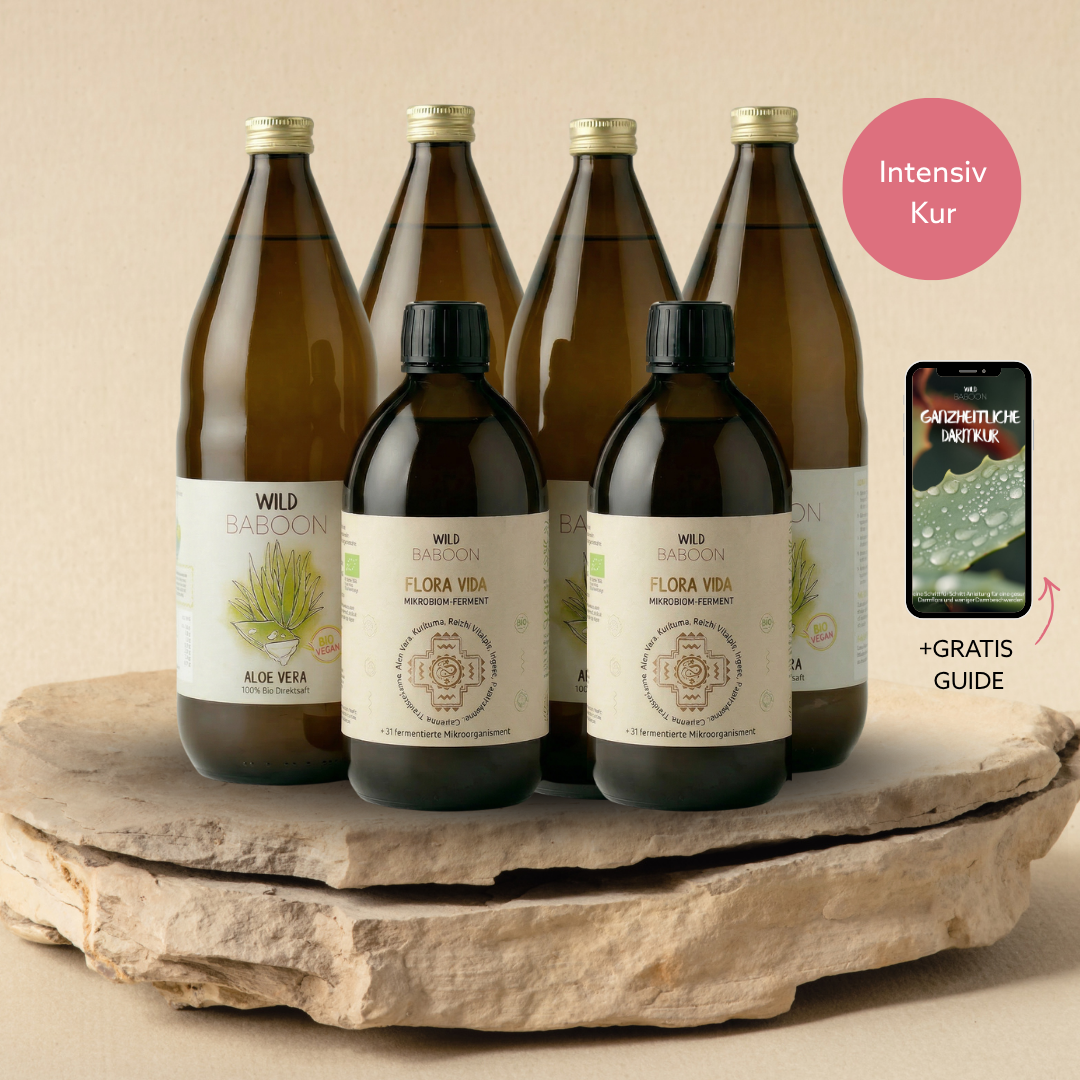
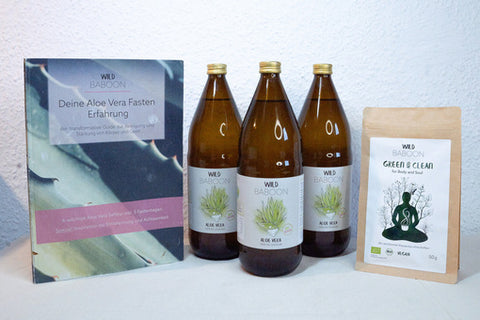
5+1: Fasting with Wild Baboon Aloe Vera Direct Juice
At a glance:
- Suitable for: healthy beginners
- Duration: 6 weeks
- Food/liquid: Wild Baboon Organic Aloe Vera Direct Juice, herbal tea, water and vegetable broth
The Aloe Vera plant is a wonderful medicinal plant and a suitable addition to fasting, as it contains proven valuable vitamins, minerals, trace elements and amino acids, such as vitamins A, B, C, E and zinc, selenium, calcium and much more.
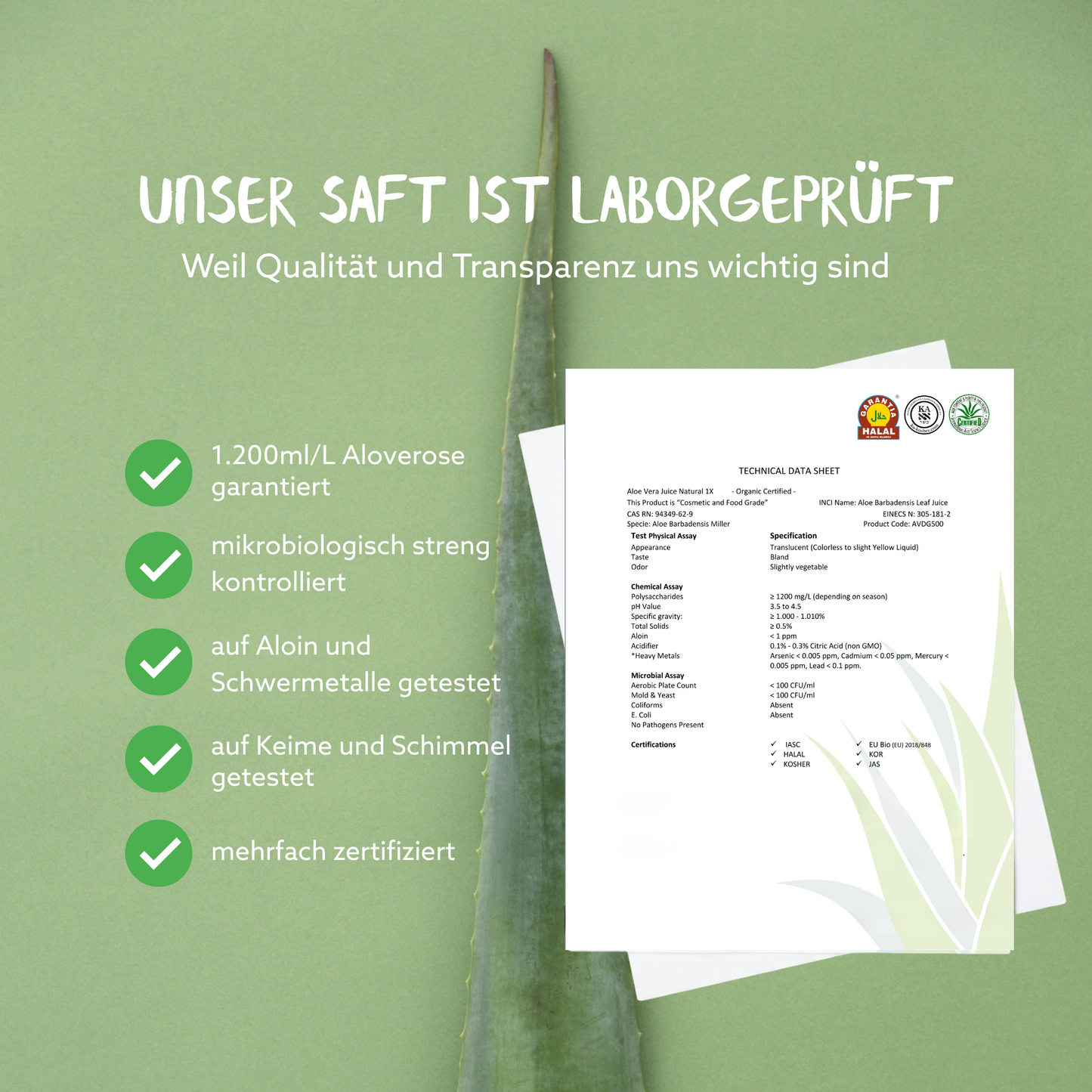
One ingredient of the Aloe Vera plant stands out in particular: Aloverose. This is a polysaccharide with attached protein molecules, which has antibacterial, antiviral, antifungal (against harmful fungi) and anti-inflammatory effects. You can read all the information in this study.
Aloe Vera juice is perceived as cooling and soothing, as we might know it from after-sun gel in summer. Aloe Vera is a great companion for the body's regeneration phase.
The introductory and especially the post-fasting phases are also very important. Therefore, it makes sense to supply the body with sufficient Aloe Vera direct juice during these two phases.
The 6-week fasting cure schedule:
- Week 1-3: Introduction
- Week 4: Fasting phase
- Week 5-6: Building phase
During the introduction phase, you maintain your usual diet and add the intake of Aloe Vera direct juice twice daily.
The fasting phase begins with a preparation day, followed by the actual fasting period without solid food (maximum 4-5 days for beginners, longer for advanced fasters), and finally 2-3 days during which you gradually reintroduce solid food.
The subsequent two-week building phase then concludes the Aloe Vera juice cleanse, by gently reintroducing your body to a normal diet.
If you're looking to embark on a fasting journey to give your body a break and relieve it, our Fasting Guide for Aloe Vera Fasting might be just what you need. With this method, you can not only give your body a healthy pause but also benefit from the diverse health advantages of Aloe Vera.
During the 6-week cure, the fasting guide will accompany you and not only offers valuable information on how to carry out the cure, but also delicious recipe ideas and a detailed nutrition plan. Treat yourself to this time out for body and mind and experience the beneficial effects of Aloe Vera fasting on your organism. Click here for the fasting guide.
The Fasting Checklist
Are you ready for a fast?
- you are generally healthy
- you often feel drained and unmotivated
- you want to feel fit and good in your body again
- you want to expel stressful "waste" and toxins from your tissues and intestines
- you want to give your body's cells the opportunity for regeneration
- you want to be productive again, both mentally and physically
- you want to let go of worries, doubts, and fears
- you want to enjoy your life radiating and self-confident
FAQ – Your Questions
How long should a beginner fast?
It largely depends on the method, but generally, a maximum of one week at the beginning is recommended.
What happens after 3 days of fasting?
When the intestines are empty, appetite usually stops after 3 days of fasting. Depending on the method, it is likely that you will already see a weight loss of 1-2 kg after 3 days. This is because the body adjusts and draws on existing fat reserves. There may also be side effects of fasting: heart rhythm and circulatory disorders, headaches, bad mood, and dizziness.
How long to fast per day?
Depending on the method, you fast for the entire day or just several hours.
What is the healthiest fasting?
There are different fasting methods, as there are people with different needs. This question cannot therefore be answered universally. It depends on many factors what the healthiest fasting is. For anyone who dares to try therapeutic fasting and carries it out properly, it is certainly a valuable natural and liberating experience.
What can I eat when I fast?
It depends on the method which foods are omitted. In most methods, solid food is avoided. With alkaline fasting, you can eat alkaline foods; with intermittent fasting, you continue your usual diet. If you want to do therapeutic fasting, you have to be content with water and Aloe Vera juice :)
What to do if you're hungry while fasting?
The basic rule is: if you're hungry, you're not fasting. Once the gut is empty, our hunger pangs stop. Nevertheless, you might feel hungry, especially during the first two days, as your body needs to adjust. If this happens, you can drink plenty of fluids or distract yourself. You should also empty your bowels.
What is the best way to start fasting?
Choose a method that is suitable for beginners and appeals to you. Make sure to gradually prepare your body for fasting by using one or more days for preparation.
How do Christians fast?
The Christian fasting period is annually between Ash Wednesday and Easter. During this time, fasting is intended as a form of penance and reflection. However, you can decide for yourself what to abstain from. Alcohol, smoking, or sugar are common.
Which type of fasting is right for me?
You can find out which method is right for you: We introduce 5+1 fasting methods and provide recommendations for the duration and recommended experience level. You can also seek advice from a (fasting) doctor or naturopath.