
Anyone looking to buy aloe vera juice quickly comes across a variety of offers – from well-known brands in multi-level marketing to lesser-known manufacturers and start-ups. But how do you find the best aloe vera juice and identify high-quality products? In this article, we show you the five most important characteristics to look for when buying, to truly benefit from the valuable ingredients of aloe vera.
In a nutshell: The most important characteristics for high-quality aloe vera juice
If you want to buy aloe vera juice, you should pay particular attention to certain ingredients and quality features. These will help you to identify the best aloe vera juice and ensure that you get a high-quality product:
- Direct juice: from Aloe Vera Barbadensis Miller
- Aloverose content: The aloverose content, or indeed the mention of this quality factor, gives you an indication of the juice's quality and the trustworthiness of the company behind it. If you find no information on aloverose, you can assume that in almost all cases it is an inferior juice.
- Organic certification: Products with organic certification have a corresponding seal, which is usually visible on the packaging.
- No thickeners or unnecessary fillers/flavorings: fewer unnecessary fillers = more space for pure direct juice
- Sustainable cultivation and fair trade: make sure that you source your products from a manufacturer that treats people and nature responsibly. Every euro sends a message and your purchasing decision has an impact.
Now let's go through the individual characteristics in more detail:
1. The best aloe vera juice = direct juice
But what exactly is direct juice and how does it differ from juice? A direct juice is a juice that is bottled immediately after pressing or made durable only by pasteurization – without concentrate production or dilution. This means it is not re-diluted from concentrate, as is the case with many juices.
Characteristics of direct juice:
- No concentrate: The juice is not thickened by evaporation and later re-diluted with water.
- Pure taste: Since no additional processing steps are necessary, the natural taste is largely preserved.
- Gentle processing: Usually, the juice is only briefly heated (pasteurized) to make it last longer, so that preservatives and other additives can be avoided. With aloe vera juice, direct juice means that it is extracted directly from the leaves, without being processed into powder or concentrate. This ensures high quality and the preservation of valuable ingredients.
2. Aloverose content - the crucial quality indicator
One of the most important quality features of aloe vera juice is so-called aloverose, also known as acemannan. This exceptional active ingredient has demonstrated its remarkable properties in numerous studies, especially its anti-inflammatory effect and the promotion of cell regeneration. Many of the most important scientific findings on aloe vera are based on its aloverose / acemannan content.
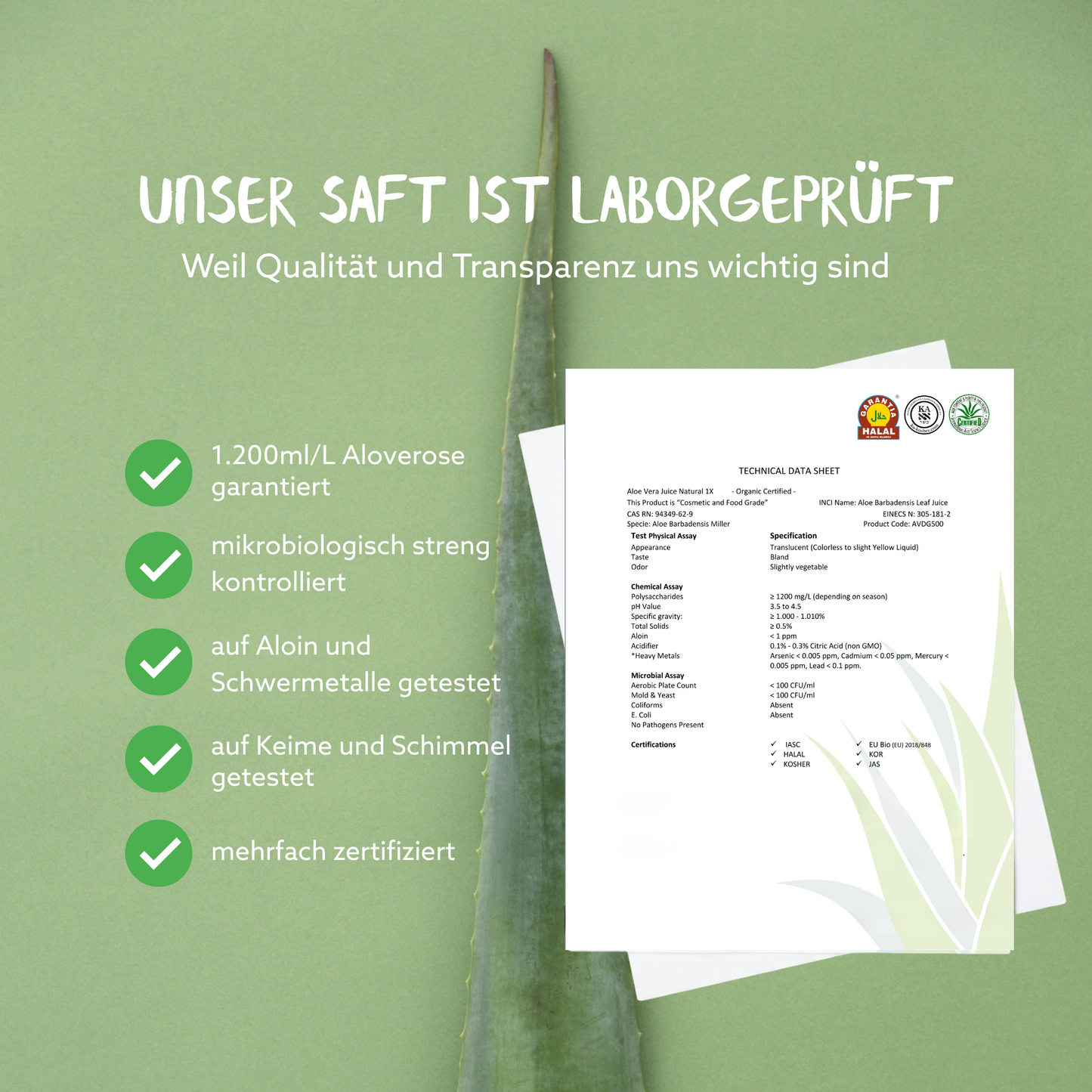
An aloe vera juice is considered particularly high-quality if it has a high aloverose content. As a rule, manufacturers emphasize the aloverose value from an amount of 1,200 mg per liter – only from this value is the juice truly of outstanding quality and worth its price. In comparison, a juice with only 300 mg per liter would mean that you would have to drink four times as much to achieve the same aloverose content. So pay close attention to the aloverose value to ensure you are holding a truly high-quality aloe vera product in your hands!
❗️Important: A high concentration of aloe vera in the juice does not automatically mean a high density of active ingredients.

The actual effect often depends on the quality of the harvested plant. The ingredient aloverose is particularly telling, as it is linked to other valuable substances. The aloverose content varies depending on the leaf – it is higher when the plant has been less fertilized and watered. The age of the leaf and climatic conditions also influence the content. The soil is particularly crucial for everything that grows. The richer and healthier the soil, the better the plants grow, and this influences the nutrient density of the end product.
Unfortunately, it is striking that some well-known brands do not even provide information on aloverose, even though this is crucial for the effectiveness and quality of the product. The active ingredient aloverose / acemannan is not even mentioned on the websites of the "big players" in the aloe vera market, and sales representatives have sometimes never even heard the name, which rightly raises eyebrows.
3. Organic certification as a characteristic for high-quality juice
Products with organic certification have an official seal, which is usually visible on the packaging. This confirms that a product has been grown, processed and manufactured according to organic standards. Organic certification is issued by independent control bodies and is subject to legal requirements, particularly in the EU, the USA and many other countries.
In Germany, there are additional organic seals that are subject to even stricter standards, such as Bioland, Naturland or Demeter. Furthermore, EU organic products always have a certification number, such as "DE-ÖKO-XXX" for the responsible inspection body.
You can find more information about the EU organic seal here.
❗️Attention: Fake organic products!
- Terms such as "natural", "from controlled cultivation" or "chemical-free" do not replace an organic certificate!
- Some products use green packaging or nature images to fake naturalness – always check for the official seal.
- Cheap "organic" products from unreliable sources (e.g., shady online shops) could be counterfeit.
4. No thickeners or unnecessary fillers/flavorings
To ensure you receive a high-quality product for your money, you should examine the list of ingredients in detail before purchasing and pay attention to the following. If these substances are contained in the juice, you should consider whether you want to opt for an alternative.
Here's the rule: The more unnecessary fillers, the less aloe vera juice it contains! You can do without:
🚫 Sweeteners (e.g. sodium cyclamate, acesulfame K, sodium saccharin)
🚫 Stabilizers: These are often added to thicken the juice, thereby suggesting freshness and naturalness to the customer.
🚫 Vitamin C (L-ascorbic acid): Usually added as an isolated vitamin so that so-called health claims such as "strengthens the immune system" can be formulated
🚫 Artificial Flavors: Brands use these ingredients in their products, for example, to influence the taste and consistency of the juice. Marketing promises are also often made that cannot be kept. The consumer protection agency has also already been critical of the substances used by a well-known manufacturer.
5. Sustainable cultivation and fair trade
An authentic and serious attitude towards sustainable and responsible production and marketing of products is the new benchmark for companies of "tomorrow". Product quality should meet consciously sustainable action here.
Especially large aloe vera brands could set standards here with innovative packaging solutions and sustainable cultivation and thus make a real difference. But in practice, it often looks different: most products are still sold in conventional plastic bottles, and the aloe vera plants do not always come from organic farming.

What to look for when buying aloe vera juice?
We recommend opting for pure aloe vera juice to avoid unnecessary additives. It is important to look for direct juice, as this preserves the valuable ingredients in their natural form. In addition, you should keep an eye on the organic certificate to ensure that the aloe vera has been grown, harvested and processed according to organic standards.
Some brands offer organic certification, declare an aloverose content of 1,200 mg per liter, and fill their products in brown glass bottles. If the juice is also a direct juice and costs between €19-28, it is likely a high-quality natural product at a fair price-performance ratio.
A word on price: Expensive is not always better. Large brands often calculate high prices because commissions are co-financed in multi-level marketing models. So pay attention to the 5 mentioned characteristics for a high-quality juice!
High-quality Aloe Vera Juice from Wild Baboon

Before we overwhelm you with a lot of text, let's let the facts speak for themselves. This is Wild Baboon Aloe Vera Direct Juice:
- organic certified according to DE-ÖKO-005
- 99.9% organic aloe vera direct juice
- 1,200-1,800mg per liter of aloverose/acemannan guaranteed
- without aloin, flavorings, thickeners or preservatives
- regular controls in German laboratories
- sustainable and responsible cultivation, hand-harvested under the Mexican sun
As a young German company from Cologne, Wild Baboon is committed to sustainable and responsible aloe vera cultivation. Our Organic Aloe Vera Direct Juice is produced on a certified farm in Mexico. This farm is recognized by the IASC (International Aloe Vera Council) – clear proof of the highest quality and sustainability.
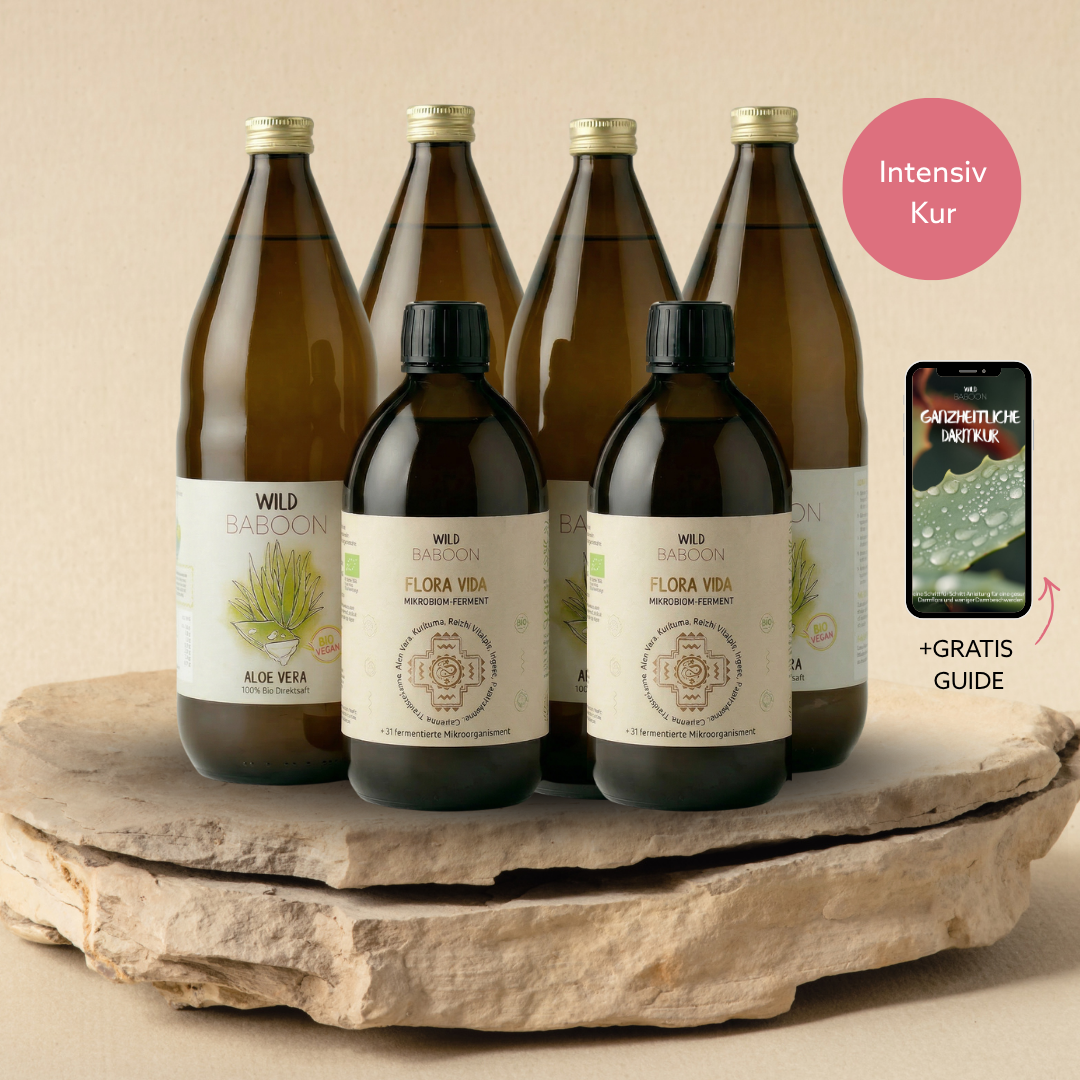
In Germany, we are also pioneers in packaging. Wherever possible, we avoid unnecessary packaging and fill our aloe vera juice (as well as all other products) into brown glass bottles. Each year, we also work with CleanHub to remove twice as much plastic from the oceans as we currently need for pump attachments. Here, too, we are constantly looking for better, more sustainable alternatives.
Read more about our way of doing business in our Fair Principles.
Convince yourself of our Aloe Vera Direct Juice and order your first bottle directly here.
FAQ - Which Aloe Vera Juice is the Best?
Which aloe vera juice is good?
A high-quality aloe vera juice is characterized by the following 5 features: direct juice (no re-dilution), aloverose content over 1,200 mg per liter, organic certification, no additives or few ingredients, and sustainable cultivation.
Is it really healthy to drink aloe vera?
Aloe vera contains a variety of nutrients, vitamins, minerals, and amino acids. It is still revered as a medicinal plant in many cultures and used for issues with the intestines, skin, hair, and much more. Read here what effect it has if you drink aloe vera regularly.
How much aloe vera juice can you drink daily?
We recommend 40ml of our Aloe Vera Direct Juice in the morning and evening on an empty stomach, but you can certainly take a little more if you feel the need.
Which aloe vera juice is suitable for horses?
Wild Baboon Organic Aloe Vera Direct Juice is suitable for horses and can be mixed into their feed daily. Start with 40ml and slowly increase the dosage up to 100ml depending on size and weight. If you compete in tournaments, check the doping list beforehand and, if necessary, stop giving your horse the organic direct juice in good time before the tournament.
Can I give my dog / cat aloe vera juice?
Yes, you can give your pets aloe vera juice. Pay attention to quality here and start with a small dosage until you see initial improvements. If you have any questions, please contact us.