
Hair is much more than a natural part of our heads. It is part of our style, expresses our personality, and defines our self-esteem. Because – everyone knows it – as soon as your hair gets greasy or you don't like your new haircut, your self-confidence also drops, and you don't feel comfortable in your own skin.
But what happens when it suddenly thins out, the hairline recedes, and more and more hair falls out? Looking in the mirror slowly becomes harder and hair loss often burdens your psyche.
Many people quickly search for treatment options, although the specific cause of your hair loss is paramount and might even be resolved quickly and naturally.
In this blog post, we will explore the causes of hair loss, differentiate between various forms, and show you why Aloe Vera can help with hair loss!
Contents: Aloe Vera for Hair Loss: Effects, Application & Tips for Hair
- When is hair loss considered pathological?
- Causes of hair loss
- 4 Types of Hair Loss
- Diffuse Hair Loss
- Alopecia Areata
- Hereditary Hair Loss
- Special Cases
- Aloe Vera for hair loss and as a hair growth agent
- Tips for a good hair structure
- The best Aloe Vera recipes for your hair
- Tip: The ideal development of Aloe Vera for your hair
- FAQ – your questions
When is hair loss considered pathological?
Depending on hair color, every person has between 90,000 and 150,000 hairs on their head. They all go through a three-stage life cycle: the growth phase, the regression phase, and the resting phase. This cycle finally ends after several years with the hair falling out, after which a new one grows back.
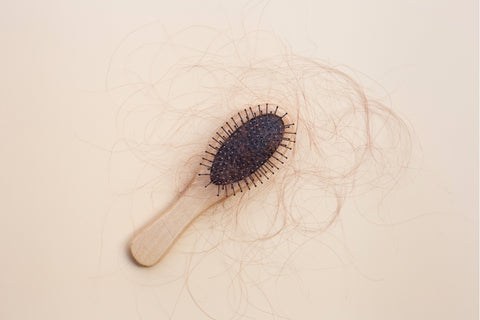
Hair in the shower drain, after brushing in the morning, or on the pillow after waking up is therefore completely normal. We all lose up to 100 hairs daily in a completely natural way. It is also normal for hair to become thinner and less dense with age.
So, when is pathological hair loss considered? Several factors must apply:
- More than 100 hairs fall out daily
- Hair no longer grows back
- Bald patches form on the scalp
If this is the case, you are probably suffering from temporary or permanent hair loss. Whether the hair will grow back depends on the type of hair loss. Doctors therefore speak of scarring and non-scarring hair loss. The former means that the hair can no longer grow back because the hair follicles are damaged.
Causes of hair loss
In Germany, approximately 40% of men and 20% of women are affected by hair loss. The cause can be very different and sometimes only affect one gender. For example, many women suffer from hair loss during lactation, and many men are affected by hereditary hair loss.
Generally, the following are possible causes of hair loss:
- Stress
- Hormonal fluctuations or hormonal changes
- Infections
- Incorrect care (products)
- Side effects of medication
- Diseases or concomitant symptoms of diseases
- Hereditary factors
- Nutrient deficiency
The exact causes of hair loss are described in the next section.
4 Types of Hair Loss
As you now know, hair loss can have many causes and can also occur in different severities and forms. But don't worry, in most cases, it is not a permanent condition, and once you know the cause, there are various treatment options.
If you yourself suffer from hair loss, you should first become aware of what form of hair loss you have and what its cause is.
Diffuse Hair Loss
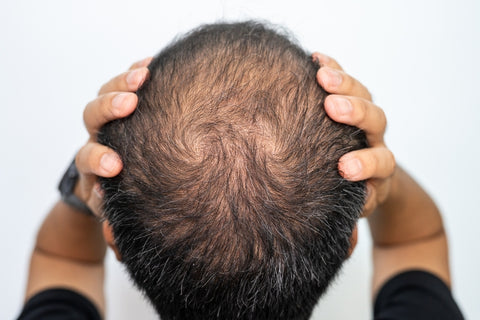
This type of hair loss is visible all over the head, as the hair thins out evenly everywhere. You lose well over 100 hairs per day, but in most cases, there are no bald spots.
The cause of diffuse hair loss (Alopecia diffusa) can be very diverse. Often, however, there is a specific trigger, and once this is found, the hair usually grows back within a few months. Since this type of hair loss usually takes some time to become visible, one should always look back a few weeks or even months when searching for the trigger.
The most common triggers include:
- Thyroid diseases
- Side effects of medications, e.g., anticoagulants, chemotherapeutic drugs, psychotropic drugs
- Vitamin A in too high a dose or lithium carbonate
- Malnutrition and diets
- Nutrient deficiency
- Iron or zinc deficiency
- Psychological stress
- Harmful substances: alcohol, nicotine, drugs
- Hormonal disorders (pill) or hormonal changes (e.g., after pregnancy)
In addition, chronic infections, chronic autoimmune diseases, heavy metal poisoning, or autoimmune diseases can be triggers for diffuse hair loss.
Infections as a cause of diffuse hair loss can occur locally on the scalp (e.g., scalp fungus, folliculitis, or psoriasis), but also affect the entire body, such as influenza or Covid-19.
Furthermore, hormones should not be underestimated, and they are often a trigger for hair loss in women, which is why we will examine this topic in more detail:
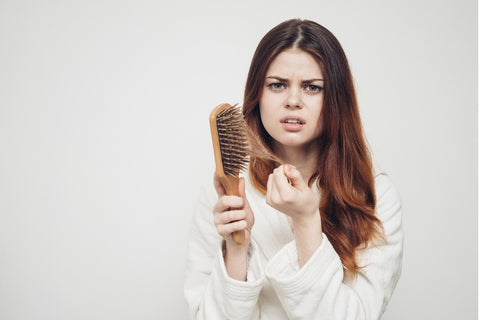
Birth control pill
As you probably know, the birth control pill can lead to many changes in the body and affect you physically as well as psychologically. If you decide to stop taking the pill, your hormonal balance will be thrown out of its artificial equilibrium and will first need to re-stabilize. This can then, in addition to other possible side effects, also lead to hair loss.
Pregnancy
During pregnancy, many women observe positive effects of hormones. Due to the increased estrogen production, hair often becomes wonderfully soft and fuller. It also grows faster and doesn't get greasy as quickly.
After pregnancy, there is an abrupt drop in estrogen levels, which can lead to diffuse hair loss. However, this usually subsides after a few months, once the hormonal balance has stabilized again.
Are you currently pregnant? Besides hormonal changes, the female body also undergoes other changes, including a growing baby bump. Many women worry about so-called stretch marks, which are a very typical change during this time. If you are one of them, you can find our tips on how to prevent stretch marks here.
Menopause
During menopause, there is also a drop in estrogen levels, which can result in hair loss.
Alopecia Areata
Alopecia areata is another form of hair loss, affecting around 2% of the population. It is characterized by a very sudden or episodic loss of hair, usually starting with several smaller patches that can merge over time.
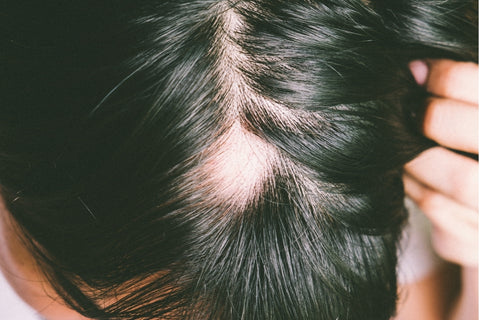
There are three different types of alopecia areata:
- Alopecia circumscripta: 80% of those affected suffer from this form of hair loss, which is limited to the scalp and does not affect other facial hair such as eyebrows or beards.
- Alopecia totalis: As the name suggests, those affected (10-20%) lose all hair on the head, including facial hair.
- Alopecia universalis: This is the rarest and also the most severe form, occurring in less than 10% of patients and affecting all body hair.
Alopecia areata often does not occur alone, but as a concomitant symptom of other diseases. Furthermore, many sufferers also have brittle, rough nails. Typical diseases include:
- Neurodermatitis
- Chronic inflammatory thyroid diseases (Hashimoto's thyroiditis)
- Addison's disease (adrenal insufficiency)
- Vitiligo (white spots disease)
- Down syndrome
The specific causes of alopecia areata are currently not yet sufficiently researched. Researchers assume that genetic disorders play a role and that it can therefore also be heritable.
According to the current state of science, it is an autoimmune disease, in which the immune cells attack the hair follicles and thus stop hair growth. However, since the follicles remain intact, there is a chance that the hair will start to grow back, which is the case for 50% of those affected.
It is also possible that external factors such as stress or infections can be a cause, but this has also not yet been sufficiently researched. A combination of genetic factors and environmental factors is likely.
Hereditary Hair Loss
When men are affected by hair loss, in most cases (80%) it is hereditary hair loss (androgenetic alopecia). For many, this begins as early as their twenties, first at the temples, and eventually spreads across the top of the head.
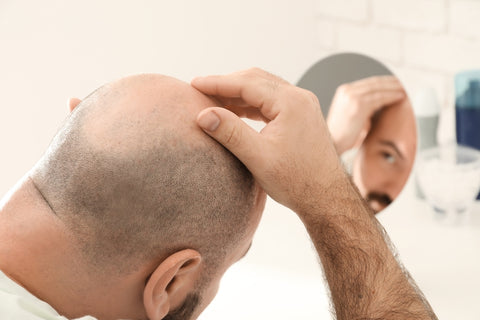
Women can also suffer from it, though less frequently. In women, hair loss is mainly visible at the parting and on the top of the head.
The cause lies in the male sex hormone testosterone, specifically its active metabolite dihydrotestosterone (DHT). It impairs the nutrient supply to the hair root, which shortens the growth phase and thus causes hair to fall out earlier. Since it is a genetically determined predisposition, androgenetic alopecia is inherited. However, there is currently not enough research to determine exactly how it is inherited.
Special Cases
Besides the three most common forms of hair loss already mentioned, there are also some rarer special cases:
- Alopecia mechanis or Alopecia traumatica: Hair loss due to pressure, pulling, or rubbing (consciously or unconsciously inflicted)
- Alopecia seborrhoica: Hair loss with an overproduction of sebum at the hair root
- Alopecia specifica: Hair loss during a syphilis infection
- Alopecia triangularis temporalis congenita: one-sided hair loss at the temples and on the front of the head in children up to nine years old
Aloe Vera for Hair Loss and as a Hair Growth Agent
Did you know that gut health plays an important role in the health of our entire body? In addition to the important task of digestion, the gut also produces many important hormones and neurotransmitters, and up to 80% of immune cells are located in the gut.
If the gut gets out of balance, it can have consequences for the entire body. This can also lead to hair loss, as a healthy gut flora is necessary for the absorption of important nutrients that are needed for hair growth. Furthermore, inflammation in the gut can trigger systemic inflammatory reactions that can lead to hair loss.
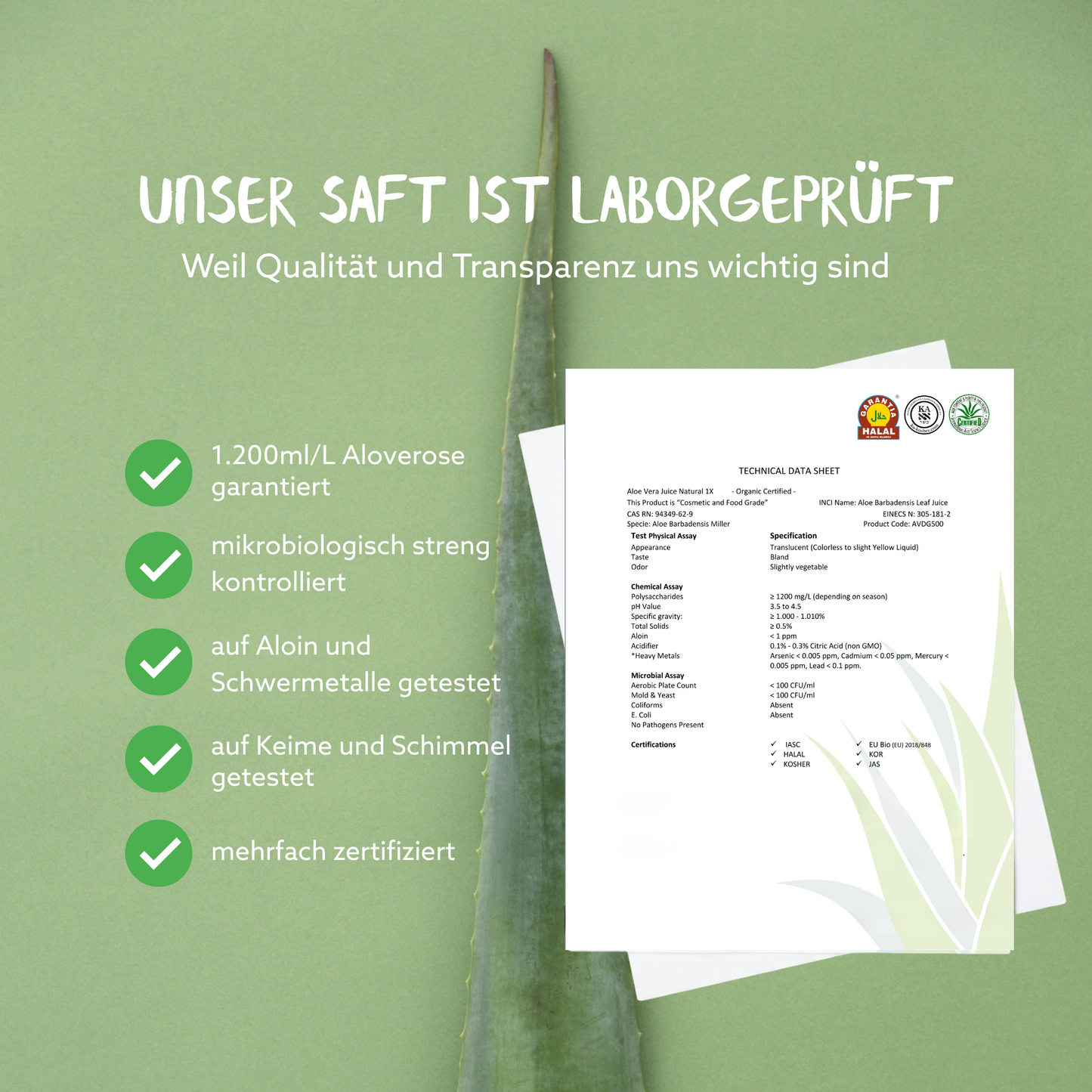
To regulate the gut, we recommend daily intake of our Aloe Vera direct juice, as the Aloe Vera plant contains ingredients that support the growth of bifidobacteria found in the gut. This is achieved through the polysaccharide aloverose and fructans, which serve as food for good gut bacteria and were investigated in this study for their prebiotic properties. You can find more about gut health and gut restoration here.
The Aloe Vera plant can also be successfully used as a hair growth agent. It is rich in enzymes, amino acids, vitamins, and minerals, which together can have a stimulating effect on hair follicle growth.
By applying Aloe Vera to the scalp, its anti-inflammatory properties can be utilized to create a healthier environment for hair growth. Furthermore, the moisturizing properties of Aloe Vera are believed to strengthen hair and protect it from damage, ultimately leading to reduced hair loss.
The results of a study on the effect of Aloe Barbadensis (Aloe Vera) leaf juice in promoting hair growth in adult males also showed a significant mean change in the degree of hair loss in participants using Aloe Vera leaf juice. This suggests that Aloe Vera can be effective as a hair growth agent.
For optimal hair health and growth, a combination of internal and external application using Wild Baboon Aloe Vera Direct Juice and Aloe Vera Gel is recommended. Get the starter set here.
For this, you should take 40ml of the juice daily in the morning and evening on an empty stomach. If needed, you can also take more.
And here's how to use the Aloe Vera Gel:
- Morning: Take two pumps of the large Aloe Vera Gel and massage it into wet hair (scalp and/or hair lengths).
- Evening: Take two pumps again, massage it into dry hair and leave it in overnight as a treatment (scalp and/or hair lengths).
Our Aloe Vera Gel is also the perfect solution for dry and itchy scalp. On one hand, aloe vera relieves itching, and on the other hand, it cools the affected areas. Especially if you store the gel in the refrigerator, it provides a pleasant cooling effect.
And the best thing about treating with Aloe Vera? It is purely natural and without side effects.
IMPORTANT: Aloe Vera cannot stop hair loss in all cases, but it can soothe the scalp, support hair structure, and create favorable conditions for healthy hair growth.

Tips for good hair structure
Even if you are not affected by hair loss or have successfully stopped it, you should consider the health of your hair. Especially due to the effects of environmental factors, sun, dyeing, and various styling products, hair structure suffers, leading to split ends, thin, brittle, or dry hair. To regenerate your hair structure, we recommend the following:
- Avoid styling products that weigh down your hair as much as possible
- Avoid frequent straightening or blow-drying of hair
- If you dye your hair, avoid substances like ammonia
- Wear your hair loose as much as possible and rarely tightly pinned up or braided too tightly
💡TIP: Regular use of our Prickly Pear Seed Oil strengthens your hair structure, adds shine, prevents hair loss, and promotes hair growth. You can find all information about the "liquid gold" here.
The best Aloe Vera recipes for your hair
Ancient peoples already recognized the moisturizing effect of Aloe Vera and used it as shampoo and hair care product [Wirth: 1986, 27].
To give your hair new strength and shine, we have compiled some Aloe Vera recipes for you that you can quickly and easily make yourself at home at any time. These are our favorites:
- Leave-in Conditioner: After washing your hair, you can apply some Aloe Vera Gel to the ends. This will moisturize them and promote bounce in curly hair.
- Hair Mask: If your hair is particularly stressed and you also suffer from a dry scalp, a hair mask is ideal. Apply the Aloe Gel to all of your hair and gently massage it into the scalp. It's best to let the gel sit for a while before rinsing it out with lukewarm water.

Tip: The ideal development of Aloe Vera for your hair
We also recommend taking Aloe Vera juice every morning as a shot. Because true beauty comes primarily from within. If your organs - especially your gut flora - are doing well, it will also show on your skin, hair, and nails. With our Wild Baboon StarterKit, you'll have both products at home: the rich Aloe Gel for your whole body and the direct juice for your all-round experience. Or you can start directly with a fasting cure and help your body detoxify and create space for new energy. You can find our fasting guide here and learn more about the topic in this blog post.
FAQ – Your Questions
What to do for hair loss?
Step 1: Find the cause and the right solution. Step 2: Follow a holistic approach. Step 3: 40 ml Aloe Vera Direct Juice morning and evening. Step 4: Two pumps of Aloe Vera Gel daily in the hair. Step 5: If no improvement is visible after 3-4 weeks, you should have a comprehensive blood test done by a doctor.
Which vitamin is missing if you have hair loss?
If you have a vitamin deficiency, you often lack B vitamins. But vitamin D and H also play a role in hair loss. Vitamins B1, B2, B6, and B12, along with many other nutrients, are all combined in the Aloe Vera plant, which is why it can be optimally used for hair loss due to vitamin deficiency.
What diseases can hair loss indicate?
Typical diseases that cause hair loss include diabetes, lupus, syphilis, thyroid diseases, infections, cancer, PCOS, and anemia.
What helps fastest against hair loss?
The faster you know the cause, the faster you can find an appropriate treatment. In principle, it is always advisable to first adopt a holistic approach. You can additionally support your body optimally through the internal and external application of the Aloe Vera plant. We recommend the combination of Aloe Vera Direct Juice and Aloe Vera Gel.
What is the reason for hair loss?
Hair loss can have various causes. It is often due to stress, hormonal fluctuations or changes, infections, incorrect care (products), side effects of medication, illnesses or accompanying symptoms of illnesses, hereditary factors, or nutrient deficiencies.
Which blood values should be examined for hair loss?
A blood analysis should primarily clarify thyroid values, iron levels, zinc levels, and vitamin levels.
When is hair loss no longer normal?
It is no longer normal if you lose more than 100 hairs per day, they do not grow back, and bald spots appear.
When does hair loss occur after birth?
Hair loss usually begins during breastfeeding, 2-5 months after birth.
What types of hair loss are there?
There are various types of hair loss; common ones include alopecia areata, diffuse hair loss, and hereditary hair loss.