
Everyone has heard of it: Aloe Vera, the plant of immortality. But where does it come from and what exactly is its secret that makes it so popular?
You can find out this and more interesting facts about this extraordinary plant in this article.
Table of contents:
Origin and History of the Aloe Vera Plant
Properties and Effects of Aloe Vera
How is Aloe Vera Gel and Juice Produced?
Origin and History of the Aloe Vera Plant
The Beginning of Ayurveda and Beauty Treatments
The fact is that the Aloe Vera plant (Latin: Aloe Barbadensis Miller) was used as a medicinal remedy in Babylon (present-day Iraq) and India in the 2nd and 3rd centuries BC. The first recipes for the use of Aloe Vera – especially the gel contained in it – were found outside India on Sumerian clay tablets around 1700 BC. In the ancient traditional Indian healing art of Ayurveda, Aloe Vera is considered a rejuvenating agent. There, the plant is called "Sanskrit Kumari". Translated, this means "young woman". According to legend, Kumari is said to have risen from the sea to await marriage with Shiva.
Columbus also carried aloe plants with him during his voyages of discovery. Through missionary work in the 16th century, Native American tribes also came into contact with Aloe Vera, which quickly became one of their sacred plants. The Maya Indians named it "fountain of youth" due to its highly effective juice.

Uses of Aloe Vera
Worldwide, there are some 450 varieties of the Aloe Vera plant, of which mainly the true Aloe, "Aloe Barbadensis Miller", is used as a medicinal and cosmetic agent. The most important main cultivation areas are in Mexico, where the desert lily can grow in nutrient-rich soils and under ideal temperature conditions. The Maya people equated Aloe Vera with shamans, as in their understanding, the soul of the plant produces healing properties and drives away diseases.
Thus, in Mexico, the custom arose of hanging Aloe Vera leaves over the entrance doors of houses and apartments to ward off diseases. Today, Aloe Vera is primarily used in cosmetics as a cream or gel, as the ingredients of the desert lily, among other things, promote cell regeneration and inhibit the skin aging process.
Properties and Effects of Aloe Vera
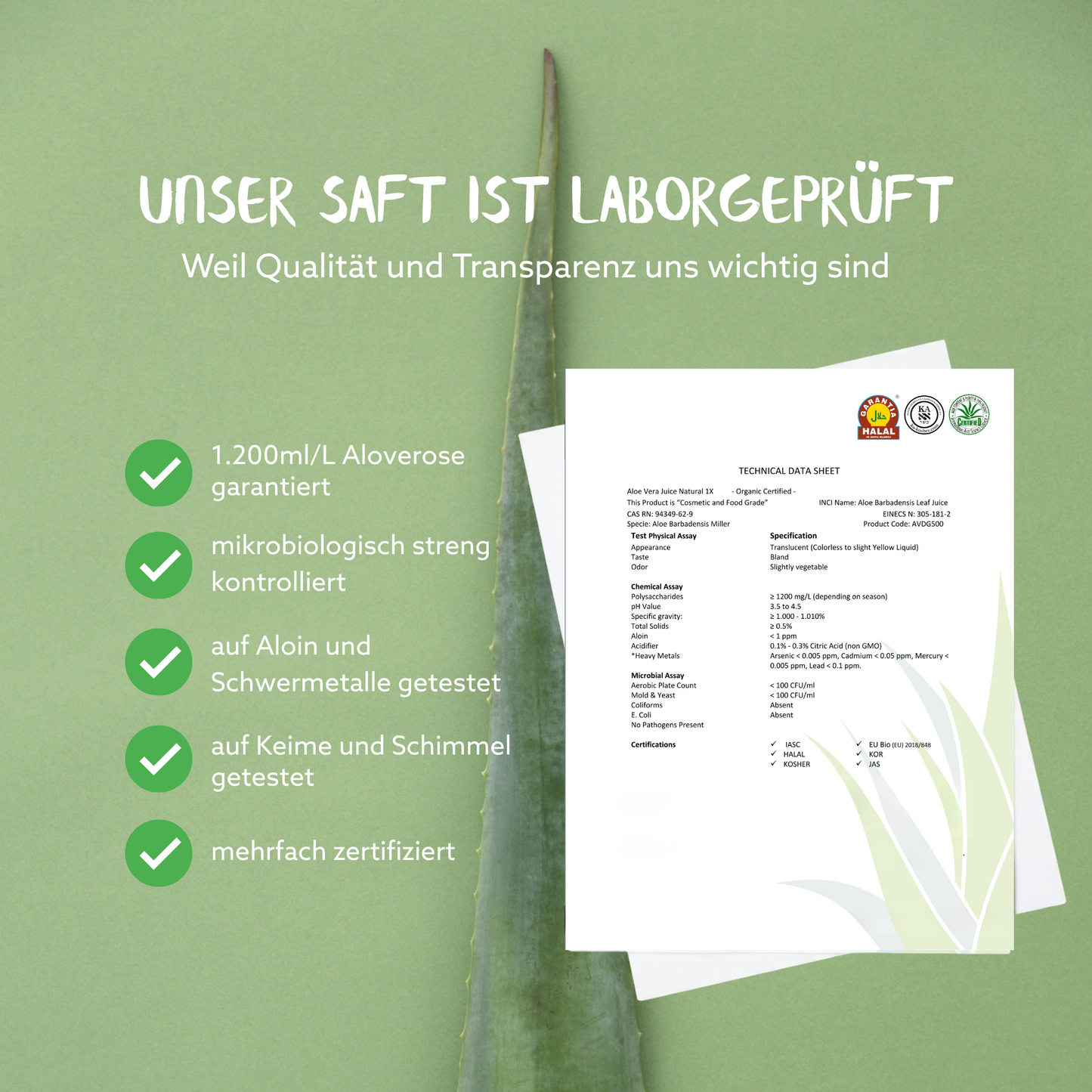
Aloe Vera is now widespread and popular as a natural remedy due to its versatile effects. It contains many ingredients to which various supportive properties are attributed. For example, aloverose, which is contained in the leaves of the plant, has antibacterial, antiviral and anti-inflammatory effects. The main ingredient aloverose (acemannan) is the quality indicator for products made from Aloe Vera. The higher the aloverose content, the higher the quality of the juice.
This also shows that a high content of other powerful, bioactive ingredients is present, which our body can use for support. It is like the food we eat: Our body metabolizes it, breaks it down into small building blocks (vitamins, minerals, trace elements, secondary plant compounds, etc.) and uses the nutrients gained where the body needs them most. More about the ingredients of Aloe Vera.
Aloe Vera as a Houseplant
Even as a houseplant, Aloe Vera unfolds its effect. It contributes to air purification. The "NASA Clean Air Study" from 1989 showed that Aloe Vera plants can purify the air by binding pollutants such as carbon dioxide or chemicals such as benzene or formaldehyde, which can be crucial for free radicals in our body. Often these substances are contained in wooden furniture or paints. Unlike various other houseplants, Aloe Vera as a houseplant releases oxygen into the air at night and can thus improve our sleep quality.
Anyone who wants to harvest their own aloe vera leaves and use them can, of course, do so. However, the full nutrient density and thus also the effect is only achieved after about 1.5 - 5 years and depends significantly on the soil in which the plant thrives. Nutrient-rich soil and ideal climatic conditions are equally beneficial. Therefore, it is particularly important that the Aloe Vera, which is to be used as direct juice or for cosmetics, grows for a correspondingly long time under ideal conditions in order to then be processed into a high-quality product.
You can find a detailed article on how to care for Aloe Vera houseplants here.

Ingredients of Aloe Vera
Scientists have so far identified more than 200 ingredients in Aloe Vera that make up its extraordinary combination of active substances. These include:
- Vitamins (such as B1, B2, B6, B12, Vitamin C, Vitamin E..)
- Trace elements and minerals (such as calcium, iron, magnesium, manganese, selenium, zinc, potassium..)
- Essential amino acids (such as tryptophan, valine, lysine, leucine..)
The most important component in Aloe Vera is the so-called aloverose, a polysaccharide also known as acemannan. Aloverose, together with the unique combination of other ingredients from the desert lily, is said to be responsible for its healing power, which has been recognized and used for millennia.
This is a long chain of combined sugar molecules, which is combined from carbohydrates with protein building blocks. The so-called proteoglycans connect human cells with each other and are directly connected to the connective tissue. Hyaluronic acid and collagen also bind to these, ensuring stability in the cell system. In addition, aloverose promotes the wound healing of the skin, as the active ingredient simultaneously accelerates cell division and the formation of new cells.
However, the active ingredient aloverose is not solely responsible for the wound-healing, soothing effect of Aloe Vera, which belongs to the succulents. Some scientific studies suggest that the secret of Aloe's success is the synergy, i.e., the interaction of the many ingredients it contains.
Aloe Vera for Athletes
Here you will find all information about Aloe Vera juice for athletes.
How is Aloe Vera Gel and Juice Produced?
To produce Aloe Vera juice and gel, the Aloe Vera leaves must be harvested and cleaned. To avoid the bitter substance aloin, the lower parts, the outermost leaf tip, and the thorns on the leaf edges are removed. This substance helps the plant protect itself from predators, has a laxative effect on humans, and should therefore not be consumed in excess.
The uppermost leaf layer is peeled on the top and bottom and then used as a base for ecological and natural fertilizer for the soil. The inner part of the leaf, which can best be described as "Aloe fillet," is then extracted and used for further processing to obtain direct juice. This is the raw material from which all other Aloe products, such as powder, gel, creams, etc., are made.

Pasteurization for Preservation
How can I use Aloe Vera?
💡Tip: If you feel you need a higher dose of Aloe Vera juice after the weekend, that's okay and probably right. Too much juice will simply be excreted. Since products on the German market should not contain aloin, no side effects are known. A few people are allergic to Aloe Vera. In this case, intake should be stopped immediately.
Aloe Vera Juice
By daily consuming at least 40 ml of Organic Aloe Vera Direct Juice with an aloverose concentration of 1,200 mg/liter, you not only provide your body with a wide range of interacting nutrients but also enrich it with the unique aloverose nutrient specific to Aloe Vera. This contributes to the normal function of various bodily processes. You can also enjoy our Aloe Vera juice in a delicious green smoothie in the morning. You can find delicious smoothie recipes here.

Aloe Vera Gel
The Wild Baboon Aloe Vera Gel can be used as part of effective natural cosmetics to help externally with skin irritations such as eczema, psoriasis, rashes, acne, clogged pores, as well as oily, dry, sensitive or sagging skin.

Why Wild Baboon?
- Purity
- Quality and
- Sustainability
They are cornerstones of our company philosophy, which is why we have our products regularly tested in German laboratories. Long-standing and strong partnerships are also very important to us, which is why we regularly visit the aloe vera plantation on-site to get a firsthand impression and ensure consistently high quality. Our Wild Baboon products are also suitable for a conscious lifestyle. They are all vegan, lactose-free, gluten-free, and low-calorie!
Our Credo and Social Commitment
We believe it's time for our own healing and for rebuilding our planet. Therefore, we not only want to bring high-quality products into German households but also use the generated funds to help create a healthy world where humans, animals, and nature can thrive together.
You can find our organic-certified aloe vera plant products in our Wild Baboon shop.
But Aloe Vera can do more – juice and gel are also suitable for animals
The well-being of our four-legged friends is important to all of us. It is all the more surprising that the power plant aloe vera can also be used very effectively and versatilely here.
You can find out more about aloe vera for animals in this article.